⚡ Quick Answer: How to Calculate Final Grade
To calculate your final grade, multiply your current class grade by its weight, multiply your final exam score by the exam’s weight, then add both values together. The formula is:
Example: (85% × 0.70) + (90% × 0.30) = 59.5 + 27 = 86.5%
📋 Table of Contents
What is a Final Grade?
A final grade is your total course score at the end of a semester — the single number (or letter) that goes on your transcript. It is not just your final exam score. It is a weighted average of everything you did in the course: homework, quizzes, assignments, midterm exams, participation, projects, and the final exam itself.
Think of it this way: your professor does not look at your final exam in isolation. They combine every assessment category according to the weight each carries. A student who scored 95% on the final but neglected homework all semester may end up with a lower final grade than a student who was consistently solid across all categories.
This is exactly why understanding the formula matters — and why checking your numbers before the final exam can tell you precisely what you need to hit your target grade.[1]
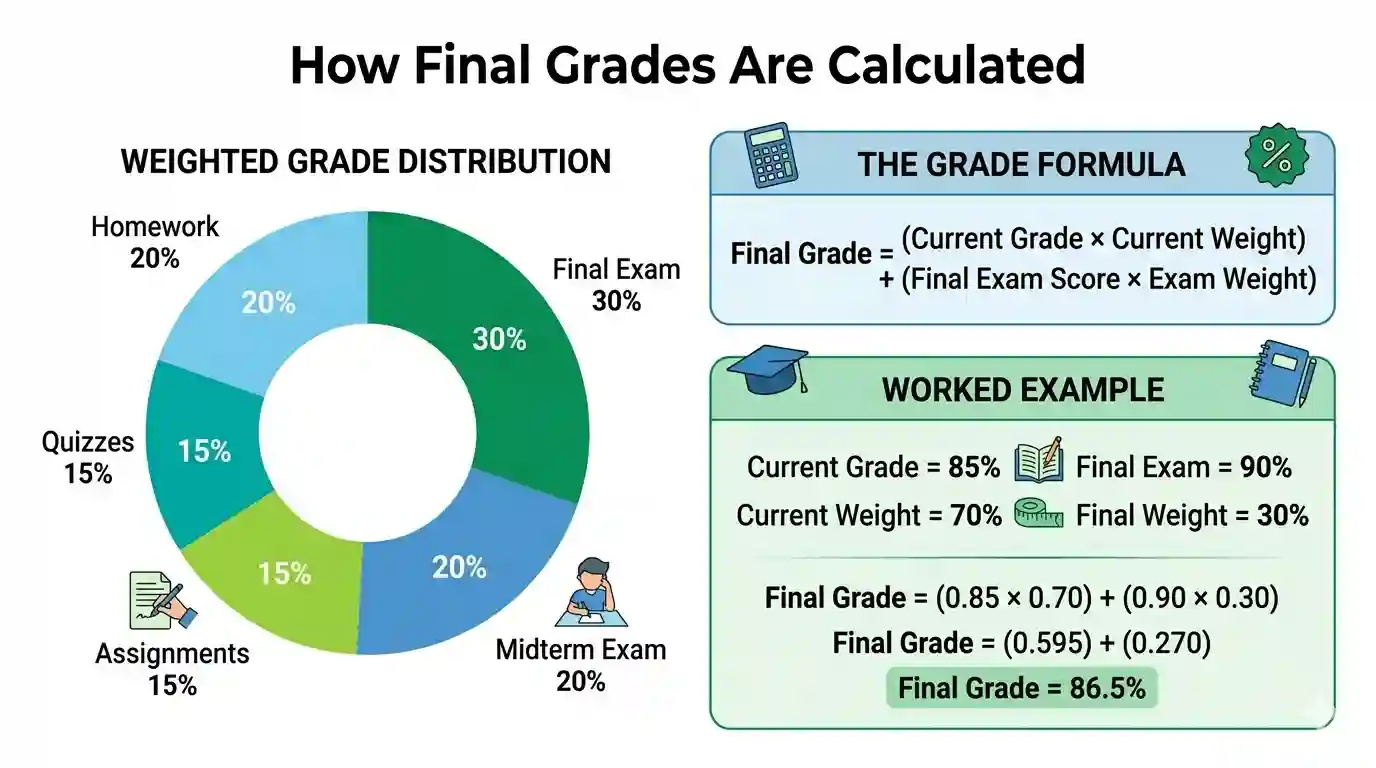
What Makes Up a Final Grade?
While the exact breakdown varies by course, most university and high school courses use a structure similar to this:
| Assessment Category | Typical Weight | Examples |
|---|---|---|
| Final Exam | 20% – 40% | Cumulative end-of-semester exam |
| Midterm Exam | 15% – 25% | Mid-semester major assessment |
| Homework | 10% – 25% | Problem sets, readings, written work |
| Quizzes | 10% – 20% | Weekly or bi-weekly short tests |
| Assignments / Projects | 10% – 20% | Lab reports, research papers, presentations |
| Participation | 0% – 10% | Attendance, in-class discussion |
All weights in your course must add up to exactly 100%. Always verify this in your syllabus before doing any calculations.
The Final Grade Formula — How It Works
The core formula for calculating a final grade in any weighted grading system comes down to one clean equation. Here it is in both plain English and mathematical notation.
Formula 1 — Calculate Your Final Grade
| Symbol | Meaning | Example Value |
|---|---|---|
| G | Final grade (what you’re solving for) | — |
| C | Current grade before the final exam | 85% |
| Wc | Weight of current grade (as a decimal) | 0.70 (i.e., 70%) |
| F | Final exam score | 90% |
| Wf | Weight of final exam (as a decimal) | 0.30 (i.e., 30%) |
The relationship between Wc and Wf is straightforward: they must add up to 1.0 (or 100%). If your final exam is worth 30%, then your current grade carries the remaining 70%.[1]
For Courses With Multiple Graded Categories
If your course has many separate categories (homework, quizzes, midterm, assignments, final exam), the full formula expands naturally:
Where W₁ + W₂ + W₃ + … + Wf = 1.0
In practice, most grade portals (Canvas, Blackboard, Moodle) calculate your current grade automatically by combining all non-final categories. So you can treat that single “current grade” number as your C value in the two-variable formula above.
What Score Do I Need on My Final? — The Required Score Formula
This is the most important calculation for students approaching exams. You know your current grade. You know your target (an A, a B, or just passing). What you need to know is exactly what score on the final will get you there.
Simply rearrange the final grade formula to solve for F (the required final exam score):
Formula 2 — Score Needed on Final Exam
Where:
G = your target overall grade (e.g., 0.90 for 90%)
C = your current grade before the final
Wc = weight of your current grade (decimal)
Wf = weight of the final exam (decimal)
Example: What do I need on my final to get an A?
Student: Current grade = 82%, Final weight = 30%, Target grade = 90% (A)
G = 0.90, C = 0.82, Wc = 0.70, Wf = 0.30
Step 2 — Apply the formula
F = (0.90 − (0.82 × 0.70)) ÷ 0.30
F = (0.90 − 0.574) ÷ 0.30
F = 0.326 ÷ 0.30
F = 1.087 → 108.7%
Result: This student cannot reach 90% — they need more than 100% on the final. ✗
When the required score exceeds 100%, the target grade is mathematically out of reach. The student should recalculate for a lower target, such as 87% or 88%.
Example: What do I need to just pass?
Student: Current grade = 55%, Final weight = 25%, Target grade = 60% (passing)
F = (0.60 − (0.55 × 0.75)) ÷ 0.25
F = (0.60 − 0.4125) ÷ 0.25
F = 0.1875 ÷ 0.25
F = 0.75 → 75%
Result: Student needs 75% on the final to pass. ✓
Use our Final Grade Calculator to skip the manual work — enter your current grade, exam weight, and target, and get the required score instantly.
Worked Math Examples — Step by Step
Here are three complete examples covering different final exam scenarios. Follow each step with your own numbers to double-check your grade.
Example 1 — Calculate Final Grade (Final Worth 20%)
Current grade: 85% · Final exam: 90% · Final weight: 20%
Step 1: 85 × 0.80 = 68.0
Step 2: 90 × 0.20 = 18.0
Step 3: 68.0 + 18.0 = 86.0%
Final Grade = 86% → B ✓
Example 2 — Calculate Final Grade (Final Worth 40%)
Current grade: 72% · Final exam: 88% · Final weight: 40%
Step 1: 72 × 0.60 = 43.2
Step 2: 88 × 0.40 = 35.2
Step 3: 43.2 + 35.2 = 78.4%
Final Grade = 78.4% → C+ ✓
Notice how a heavy final (40%) and a strong exam performance can significantly lift an otherwise average grade.
Example 3 — What Score Needed to Get B (80%)?
Current grade: 78% · Final weight: 25% · Target: 80%
F = (0.80 − (0.78 × 0.75)) ÷ 0.25
F = (0.80 − 0.585) ÷ 0.25
F = 0.215 ÷ 0.25
F = 0.86 → 86%
Result: Student needs 86% on the final to finish with 80% overall. ✓
Grading Scenarios — What You Need on the Final
The table below covers the most common pre-final grade situations. All values are calculated using the required score formula. Use this as a quick reference before your exams.
| Current Grade | Final Weight | Target Grade | Needed on Final | Achievable? |
|---|---|---|---|---|
| 95% | 20% | A (90%) | 63.8% | ✅ Yes — easily |
| 90% | 20% | A (90%) | 90.0% | ⚠️ Yes — maintain performance |
| 82% | 30% | A (90%) | 108.7% | ❌ No — out of reach |
| 82% | 30% | B (85%) | 97.7% | ⚠️ Very difficult |
| 82% | 30% | B (83%) | 85.3% | ✅ Yes — achievable |
| 75% | 40% | B (80%) | 87.5% | ⚠️ Yes — requires strong effort |
| 68% | 25% | Pass (60%) | 36.0% | ✅ Yes — comfortable margin |
| 50% | 30% | Pass (60%) | 80.0% | ⚠️ Possible — needs strong final |
| 40% | 25% | Pass (60%) | 110.7% | ❌ No — mathematically impossible |
All “Needed on Final” values are calculated using: F = (Target − (Current × Current Weight)) ÷ Final Weight. Values above 100% are mathematically unachievable with standard scoring.
Weighted vs Unweighted Grades — What Is the Difference?
Before you can correctly apply the formula above, you need to confirm which grading system your course uses. These two systems are fundamentally different — and confusing them is one of the most common mistakes students make.[2]
| Feature | Weighted Grades | Unweighted Grades |
|---|---|---|
| Definition | Categories have different levels of importance | Every assignment counts equally |
| Calculation | Weighted average using category weights | Simple arithmetic mean of all scores |
| Common in | Universities, high schools, professional courses | Some elementary/middle schools, simple courses |
| Example | Final exam (30%) matters more than a quiz (5%) | A quiz and an exam are treated identically |
| Formula used | G = Σ(Score × Weight) | G = Sum of all scores ÷ Number of scores |
| Final exam impact | Can significantly shift overall grade | One exam among many — smaller effect |
Common Grading Systems — Percentage, Letter Grade & GPA
Once you have calculated your final grade percentage, you need to know what letter grade or GPA it corresponds to. Different countries and institutions use different scales — here are the most widely used.
US Standard Letter Grade Scale
| Percentage | Letter Grade | GPA (4.0 Scale) | Description |
|---|---|---|---|
| 97 – 100% | A+ | 4.0 | Exceptional |
| 93 – 96% | A | 4.0 | Excellent |
| 90 – 92% | A− | 3.7 | Excellent |
| 87 – 89% | B+ | 3.3 | Above average |
| 83 – 86% | B | 3.0 | Good |
| 80 – 82% | B− | 2.7 | Good |
| 77 – 79% | C+ | 2.3 | Average |
| 73 – 76% | C | 2.0 | Average |
| 70 – 72% | C− | 1.7 | Below average |
| 67 – 69% | D+ | 1.3 | Poor |
| 60 – 66% | D | 1.0 | Poor — barely passing |
| Below 60% | F | 0.0 | Failing |
UK Grading System
| Percentage | Classification | Common Term |
|---|---|---|
| 70% and above | First Class Honours | 1st |
| 60% – 69% | Upper Second Class | 2:1 |
| 50% – 59% | Lower Second Class | 2:2 |
| 40% – 49% | Third Class Honours | 3rd |
| Below 40% | Fail | — |
GPA values listed follow the most common US 4.0 scale as described by the College Board.[3] Some institutions use slightly different cutoffs — always verify with your registrar office.
Common Mistakes to Avoid When Calculating Final Grades
These errors show up constantly — and each one produces a wrong answer that could leave a student either falsely confident or unnecessarily panicked. Knowing them in advance saves you from a bad surprise after the exam.
1. Multiplying by 20 instead of 0.20
The single most common arithmetic error. If your final is worth 20%, you must multiply by 0.20 — not 20. Using 85 × 20 = 1700 is completely wrong. Always convert percentage weights to decimals before plugging into the formula.
2. Weights that do not add up to 100%
If your current weight and final exam weight do not add up to exactly 100%, your formula is broken. For example: if the final is worth 30%, your current grade carries 70% — not 80%, not 60%. Double-check your syllabus. If something is missing (like a participation component), include it in your current grade’s cumulative weight.
3. Using the wrong current grade
Your “current grade” must reflect all completed work — not just one recent test or your homework average. Log into your grade portal and use the overall course grade displayed there, not the grade from one specific category. Using only your midterm score as C will produce a very different (and wrong) result.
4. Assuming the professor will round up
Many students calculate that they need 89.4% and assume it rounds to 90%. Some professors do round half-points up; many do not. Never rely on rounding as part of your exam strategy. Calculate what you need to hit the hard threshold (90.0%), and treat rounding as a bonus, not a guarantee.
5. Ignoring extra credit or dropped lowest scores
Some courses automatically drop the lowest quiz score or offer extra credit assignments. If these apply to your course, your effective current grade may be higher than what you see — or there may be additional points available to improve your position before the final. Always check the full policy in your syllabus.
6. Calculating too early (incomplete grades)
If there are still assignments or quizzes to be submitted before the final exam, your current grade is not yet finalized. Calculating your required final score before all pre-final work is graded can produce a misleading result. Wait until all non-final grades are in before applying the formula.
Calculate Your Final Grade Now — Free Tool
You now have the formula, the examples, and a complete understanding of how weighted grading works. If you want to skip the manual calculation entirely, use our free tool — enter your current grade, final exam weight, and target grade, and get your required score instantly.
Free · No sign-up · Works on mobile · Instant result
References & Sources
This article is based on academic grading policies, peer-reviewed educational research, and guidelines from recognised academic institutions. All sources were accessed in April 2026.
- Massachusetts Institute of Technology, Registrar’s Office. Grading and Grade Point Averages. Cambridge: MIT; 2024. Available at: registrar.mit.edu. — Source for weighted grade methodology and cumulative grade calculations.
- Carnegie Mellon University, Eberly Center for Teaching Excellence. Grading and Assessment: Understanding Weighted Categories. Pittsburgh: CMU; 2023. Available at: cmu.edu. — Source for weighted vs unweighted grading systems and common grading structures.
- College Board. How to Convert Your GPA to a 4.0 Scale. New York: College Board; 2024. Available at: bigfuture.collegeboard.org. — Source for US percentage-to-GPA conversion scale and letter grade thresholds.
- University of Oxford, Academic Administration Division. Degree Classification — Marking and Assessment Guidelines. Oxford: University of Oxford; 2024. — Source for UK Honours degree classification percentages (First, 2:1, 2:2, Third).
- Walvoord B, Anderson VJ. Effective Grading: A Tool for Learning and Assessment in College. 2nd ed. San Francisco: Jossey-Bass; 2010. — Foundational academic reference on weighted grading design and grade calculation in higher education.
Written by Rana Muhammad Abdullah
MERN Stack Developer & Tool Maker · Mechatronics & Control Engineering Student · LinkedIn
Content based on university grading policies, College Board guidelines, and peer-reviewed educational research. See full references above.
Your final grade is not a mystery — it is a calculation. Run the numbers before the exam, know exactly what you need, and walk in with a plan.