⚡ Quick Answer: How to Calculate a Loan Payment
Use the standard loan payment formula: M = P × [r(1+r)^n] ÷ [(1+r)^n − 1]. Where P is the loan amount, r is the monthly interest rate (annual rate ÷ 12), and n is the total number of monthly payments (years × 12). For a $10,000 loan at 8% annual interest over 3 years, the monthly payment is $313.36.
Why You Should Calculate Your Loan Payment Before Borrowing
Most people focus on the loan amount — and completely miss the monthly payment. That is how overborrowing happens. A $25,000 car loan at 9% over 60 months sounds manageable until you realize the monthly payment is $519 and the total interest paid is over $6,000. Running the numbers before you sign changes everything.
A loan payment is the fixed amount you pay to your lender every month. Each payment covers two things: a portion that reduces your principal (the amount you originally borrowed) and a portion that covers interest (the lender's charge for lending you money). Understanding how these two components split — and how that split changes month by month — is the foundation of smart borrowing.
Whether you are taking a personal loan, financing a car, applying for a mortgage, or repaying a student loan — the calculation method is the same. The monthly loan payment formula, the loan EMI calculation, and the concept of an amortization schedule all flow from a single equation. This guide walks through all of it — no financial background required.
Three Things That Determine Your Monthly Payment
Before touching any formula, it helps to understand the three levers that control your monthly payment:
| Variable | What it is | Effect on payment |
|---|---|---|
| Loan Amount (Principal) | The total amount you borrow | Higher amount → higher payment |
| Interest Rate | Annual cost of borrowing, as a percentage | Higher rate → higher payment |
| Loan Term | How many months or years to repay | Longer term → lower payment but more total interest |
Stretching the loan term reduces the monthly payment — but it increases the total interest you pay over the life of the loan. Shortening the term does the opposite. This trade-off is at the heart of every borrowing decision.
Key Inputs Needed to Calculate a Loan Payment
Before applying the formula, gather these four pieces of information. They appear on every loan offer sheet — if a lender cannot provide all four clearly, that is a red flag.
| Input | Symbol | Meaning | Example |
|---|---|---|---|
| Loan Amount | P | Principal — total amount borrowed | $10,000 |
| Annual Interest Rate | Annual r | Yearly cost of the loan as a percentage | 8% per year |
| Loan Term | n (months) | Total repayment period in months | 36 months (3 years) |
| Payment Frequency | — | How often payments are made | Monthly (most common) |
This guide uses monthly payments — the standard in most personal loans, car loans, and mortgages worldwide. If your loan uses biweekly or weekly payments, the formula is the same but you divide the annual rate by 26 (biweekly) or 52 (weekly) and adjust the payment count accordingly.
The Monthly Loan Payment Formula — Explained
The Standard Amortization Formula
Where:
M = Monthly payment
P = Principal (loan amount)
r = Monthly interest rate (annual rate ÷ 12)
n = Total number of monthly payments (years × 12)
This formula is used universally — by banks, lenders, and financial software worldwide. In South Asia, the same formula drives what is called the EMI (Equated Monthly Instalment) calculation. The name differs; the math is identical.
How to Convert Inputs Before Using the Formula
Two conversions are required before plugging in your numbers. These are the most common sources of error when people calculate manually:
Convert Annual Rate → Monthly Rate
Example:
8% ÷ 12 = 0.6667%
= 0.006667 (decimal)
Convert Years → Months
Example:
3 years × 12
= 36 months
Always use the decimal form of the monthly rate — 0.006667, not 0.6667% — when applying the formula. Forgetting this conversion is one of the most common calculation mistakes.
Step-by-Step Worked Example — $10,000 Personal Loan
Let us walk through a complete, realistic calculation from beginning to end. No shortcuts — every step shown.
Loan Details
Loan Amount
$10,000
Annual Interest
8%
Loan Term
3 Years
Step 1 — Convert annual rate to monthly
Step 2 — Convert years to months
Step 3 — Apply the formula
Numerator: r × (1+r)^n = 0.006667 × 1.27024 = 0.008469
Denominator: (1+r)^n − 1 = 1.27024 − 1 = 0.27024
M = 10,000 × (0.008469 ÷ 0.27024)
M = 10,000 × 0.031336
M = $313.36
Step 4 — Calculate total cost and total interest
Total interest = $11,281 − $10,000 = $1,281
| Result | Value |
|---|---|
| Monthly Payment | $313.36 |
| Total Amount Paid | $11,281 |
| Total Interest Paid | $1,281 |
| Loan Term | 36 months |
You do not need to run these steps every time. Use our Loan Payment Calculator to get your result instantly — enter your principal, rate, and term, and the calculator does the rest.
Loan Amortization Schedule — How Every Payment Breaks Down
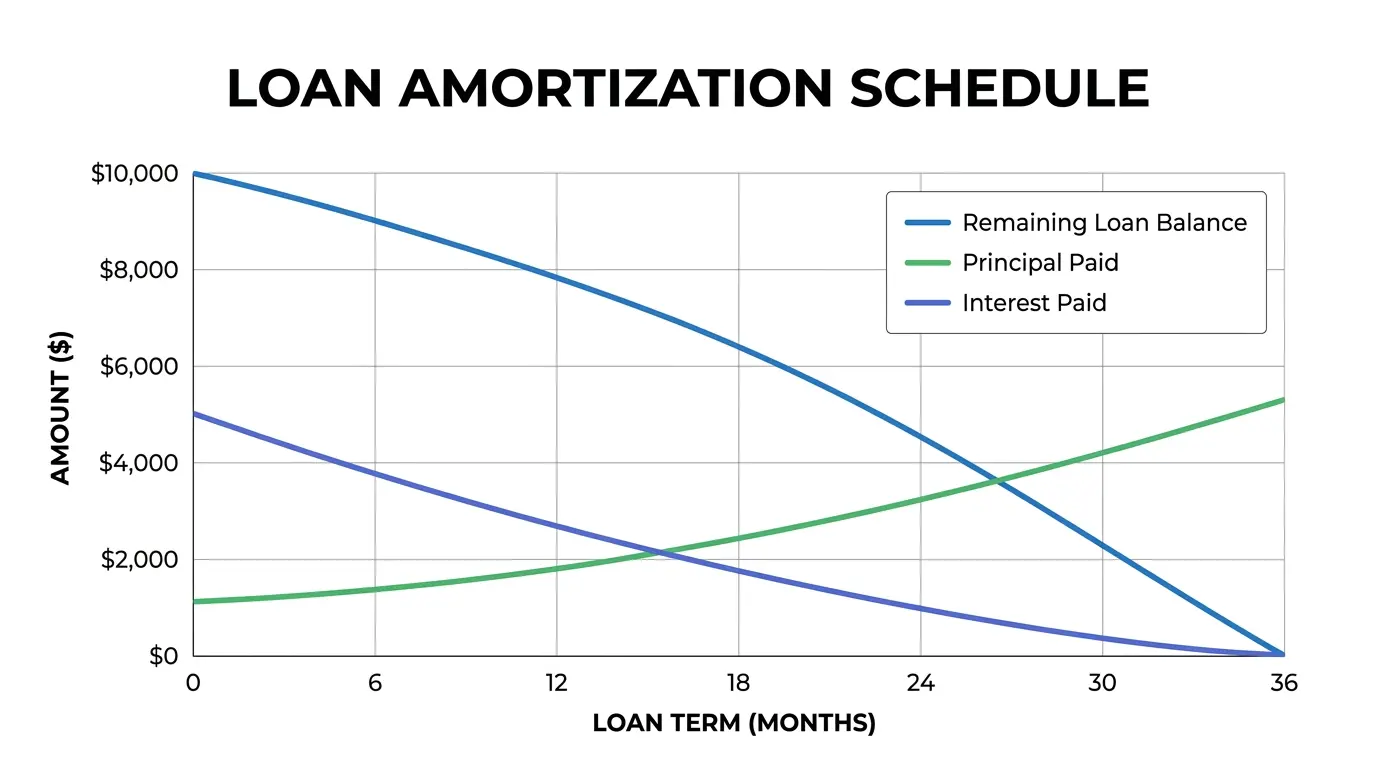
An amortization schedule is a complete month-by-month breakdown of every payment you make. It answers the question most borrowers never ask: how much of this payment actually reduces my debt?
The answer surprises most people. In the early months, the majority of each payment goes toward interest — not principal. This is because interest is calculated on the full outstanding balance, which is at its highest point when you first borrow. As your balance falls, each month's interest charge shrinks, and more of your fixed payment goes toward reducing principal. This gradual shift is called amortization.
Sample Amortization Table — First 5 Payments
Based on the $10,000 loan at 8% over 36 months ($313.36/month):
| Payment # | Payment | Principal | Interest | Remaining Balance |
|---|---|---|---|---|
| 1 | $313.36 | $246.69 | $66.67 | $9,753.31 |
| 2 | $313.36 | $248.34 | $65.02 | $9,504.97 |
| 3 | $313.36 | $250.00 | $63.37 | $9,254.97 |
| 12 | $313.36 | $264.11 | $49.25 | $7,127.18 |
| 24 | $313.36 | $281.78 | $31.58 | $4,456.41 |
| 36 | $313.36 | $311.26 | $2.09 | $0.00 |
Notice how Payment #1 sends $66.67 to interest but Payment #36 sends only $2.09. The monthly payment amount never changes — but the proportion going to interest steadily falls throughout the loan life.
What Happens When You Pay Extra?
Extra payments are one of the most powerful — and most underused — tools in personal finance. When you pay more than your required monthly payment, the excess goes entirely toward principal. This reduces the balance on which interest is calculated next month, creating a compounding effect over time.
The impact is largest when you make extra payments early in the loan — because that is when the balance is highest and interest is consuming the most of each payment. A single extra payment in month 1 saves more interest than the same extra payment in month 30.
Extra Payment Example — $10,000 at 8% over 36 Months
Standard Payment
$313.36 / month
Total paid: $11,281
Total interest: $1,281
Payoff: 36 months
With Extra $50/Month
$363.36 / month
Total paid: ~$10,861
Total interest: ~$861
Payoff: ~28 months
Extra $50/month saves approximately $420 in interest and cuts repayment by 8 months
If you receive a bonus, tax refund, or freelance payment, consider directing a portion toward your loan principal. Even a single lump-sum extra payment mid-loan can meaningfully reduce total interest. Always confirm with your lender that there is no prepayment penalty before doing this.
Interest Rate Comparison — How Rate Changes Your Total Cost
A difference of just 3–4 percentage points in interest rate can add hundreds of dollars to your total repayment. The table below illustrates this clearly — same $10,000 loan, same 36-month term, different interest rates:
| Interest Rate | Monthly Payment | Total Paid | Total Interest |
|---|---|---|---|
| 5% | $299.71 | $10,790 | $790 |
| 8% | $313.36 | $11,281 | $1,281 |
| 12% | $332.14 | $11,957 | $1,957 |
| 18% | $361.34 | $13,008 | $3,008 |
| 24% | $392.00 | $14,112 | $4,112 |
Going from 5% to 18% on a $10,000 loan costs you an extra $2,218 in interest over the same 3-year period. This is why improving your credit score before applying — or shopping around for a better rate — is one of the highest-return financial moves you can make.
Applying the Formula Across Different Loan Types
The same amortization formula works across virtually every type of fixed-rate installment loan. What changes is not the formula — but the typical principal amounts, interest rates, and repayment terms involved.
🏠 Mortgage Loans
The largest loan most people ever take. Same formula applies but with much larger principals ($100,000–$1M+) and longer terms (15–30 years). Over 30 years, total interest can easily exceed the original loan amount.
Typical term: 15–30 years · Rate: 4–8%
🚗 Car Loans (Auto Loans)
Standard fixed-rate installment loans. The formula applies directly. Because terms are shorter (3–7 years), total interest is lower than mortgages, but the rate is often higher.
Typical term: 36–84 months · Rate: 5–15%
💳 Personal Loans
Unsecured loans used for anything from debt consolidation to home improvement. Higher interest rates than secured loans because there is no collateral. The worked example in this guide uses a personal loan.
Typical term: 12–60 months · Rate: 7–25%
🎓 Student Loans
Government-backed student loans may use income-driven repayment plans rather than standard amortization. However, standard fixed repayment plans follow the same formula exactly.
Typical term: 10–25 years · Rate: 3–9%
🏢 Business Loans
Installment-based business loans (term loans) use identical amortization mechanics. Some business loans use interest-only periods followed by principal repayment — in those cases, a modified calculation is needed. For standard term loans, the formula above applies directly.
Typical term: 1–10 years · Rate: 6–30%
Common Mistakes When Calculating Loan Payments
These are the errors that cause people to underestimate their true loan cost. Each is easy to avoid once you know it exists.
1. Forgetting to convert annual rate to monthly
This is the most common error. The formula requires the monthly rate (r), not the annual rate. If your loan is 8% per year, you must use 0.006667 in the formula — not 0.08. Using the annual rate directly will produce a wildly incorrect result.
2. Ignoring fees and origination charges
Many lenders charge origination fees (0.5–8% of the loan), processing fees, or insurance premiums on top of the stated interest rate. These do not show up in the monthly payment formula but are part of the true cost. The APR figure accounts for these — the interest rate figure does not.
3. Using the wrong loan term unit
The formula uses months for n — not years. A 5-year loan is 60 months, not 5. Plugging 5 into the formula instead of 60 will produce a completely wrong monthly payment and apparent total cost.
4. Confusing APR with the interest rate
Lenders sometimes advertise the interest rate but quote the APR in fine print, or vice versa. The interest rate drives the formula. The APR reflects total borrowing cost including fees. When comparing two loan offers, compare APR — not just the headline interest rate.
5. Assuming a longer term always saves money
A longer loan term reduces monthly payments but dramatically increases total interest paid. A $20,000 car loan at 7% over 48 months costs $1,856 in interest. Stretched to 72 months, the same loan costs $2,826 in interest — $970 more — even though the monthly payment feels more comfortable.
APR vs Interest Rate — What Is the Difference?
This distinction matters more than most borrowers realize. Understanding it ensures you are comparing loan offers on a level playing field.
| Term | What it measures | Used for |
|---|---|---|
| Interest Rate | The annual cost of borrowing the principal only | Calculating the monthly payment (M in the formula) |
| APR (Annual Percentage Rate) | Interest rate + all lender fees, expressed annually | Comparing the true total cost across different lenders |
Practical Example
Lender A offers a 7.5% interest rate with no fees. Lender B offers a 7.0% interest rate but charges a 2% origination fee ($200 on a $10,000 loan). Lender B's APR, after including the fee spread across the loan term, works out to approximately 8.5% — making it the more expensive option despite the lower headline rate.
Always ask for the APR figure, not just the interest rate, when comparing loan offers.
In Pakistan and other South Asian markets, some lenders quote a flat rate rather than a reducing balance rate. A flat rate of 8% on a $10,000 loan means you pay interest on the original $10,000 throughout the term — even as you repay the principal. This is significantly more expensive than a reducing balance (amortizing) loan at the same stated rate. Always clarify which method your lender uses.
How Much Loan Can You Afford? — Affordability Guidelines
Knowing your monthly payment is step one. Knowing whether you can comfortably afford it — without stretching your finances to the breaking point — is step two. Two frameworks help here.
The 28/36 Rule
A widely used guideline for mortgage borrowers:
- Monthly housing costs (mortgage + insurance + taxes) should not exceed 28% of gross monthly income
- Total monthly debt payments (all loans combined) should not exceed 36% of gross monthly income
Example: On a $5,000/month gross income, total debt should stay under $1,800/month.
Debt-to-Income Ratio (DTI)
DTI = total monthly debt payments ÷ gross monthly income
- Below 36%— generally comfortable, most lenders approve
- 36–43%— borderline; lender discretion varies
- Above 43%— high risk; many lenders will decline
Quick Affordability Check — Before You Borrow
- Calculate your proposed monthly payment using the formula above
- Add it to all existing monthly debt payments (car loan, credit card minimums, other loans)
- Divide that total by your gross monthly income
- If the result is above 0.36 (36%), reconsider the loan amount or term
These ratios are guidelines, not rules — your personal cash flow, job stability, and savings cushion all matter. But they give you a fast sanity check before you commit to a monthly obligation.
Calculate Your Loan Payment Now — Free Tool
Now that you understand the formula, the amortization mechanics, and what affects your total cost — check your own numbers using our free tool. Enter your loan amount, interest rate, and term to instantly see your monthly payment, total interest, and a full amortization schedule. No sign-up required.
Open Loan Payment Calculator →Free · No sign-up · Works on mobile · Metric & imperial · Full amortization schedule included
References & Sources
This article is based on standard financial mathematics and guidelines from internationally recognised financial bodies. All sources were verified in April 2026.
- Consumer Financial Protection Bureau (CFPB). What is the difference between a loan's interest rate and its APR? Available at: consumerfinance.gov. — Source for APR vs interest rate distinction.
- Investopedia. Amortization: Definition, Formula, and Calculation. Available at: investopedia.com. — Source for amortization schedule explanation and formula derivation.
- Federal Reserve. Consumer Handbook on Adjustable-Rate Mortgages. Board of Governors of the Federal Reserve System. — Source for loan term and repayment structure principles.
- Bankrate. Debt-to-income ratio: What is it and how to calculate it. Available at: bankrate.com. — Source for debt-to-income ratio guidelines and the 28/36 rule.
- Mishkin, F.S. The Economics of Money, Banking, and Financial Markets. 12th ed. Pearson, 2018. — Foundation source for amortization mathematics and loan pricing principles.
Written by Rana Muhammad Abdullah
MERN Stack Developer & Tool Maker · Mechatronics & Control Engineering Student · LinkedIn
Content based on standard amortization mathematics, CFPB guidelines, and peer-reviewed financial literature. See full references above.
The loan payment formula takes 30 seconds to run. The financial clarity it gives you lasts the entire life of the loan.