Whether you are aiming for the Dean's list, applying for an scholarships, or preparing your resume for technical roles, maintaining an accurate CGPA is essential. Simply input your semester-wise points and credits to see where you stand on the 4.0 scale.
The Mathematics of Academic Success
Identify Quality Points
Multiply the numerical value of your grade by the credit weight of the course.
Aggregate Sums
Add all Quality Points from every semester and divide by the total credits attempted.
Apply Weighting
Adjust for Honors (+0.5) or AP/IB (+1.0) to find your Weighted CGPA.
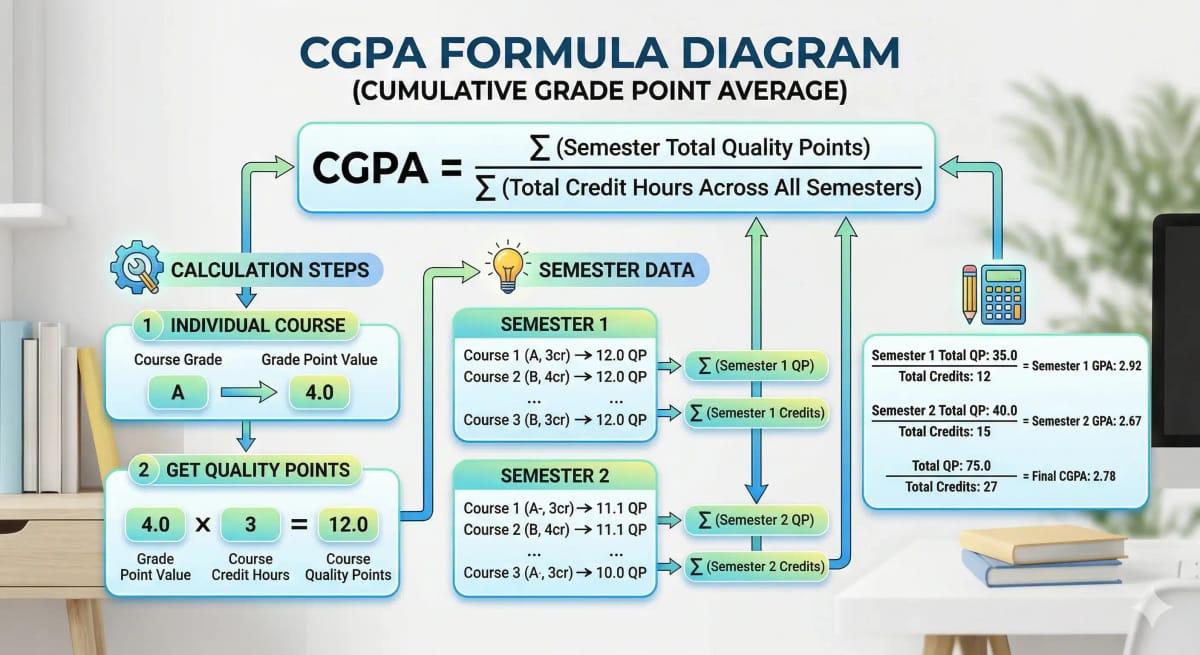
CGPA Formula (Step-by-Step Calculation with Example)
CGPA vs. GPA vs. SGPA
CGPA: Cumulative performance across your entire degree program.
GPA: Often refers to a specific term or a single course grade.
SGPA: Your performance specifically for one semester.
How to Calculate Your CGPA in 3 Simple Steps
Tracking your cumulative performance doesn't have to be complicated. Whether you are using a 4.0 scale or a percentage-based system, follow this streamlined process to find your current standing:
Determine Your Grade Points for Each Course
First, convert your letter grades into their numerical equivalents based on your school's grading scale.
- Regular Classes: A = 4.0, B = 3.0, C = 2.0.
- Honors/AP Classes: Add 0.5 or 1.0 to the standard value for weighted calculations.
Calculate Total Quality Points
Quality points represent the "weight" of your grade relative to the course's difficulty and time commitment.
Formula: Grade Point Value × Credit Hours = Quality PointsExample: An 'A' (4.0) in a 3-credit Calculus class gives you 12 Quality Points.
Divide by Total Attempted Credits
Finally, sum up all quality points earned across every semester and divide by the total number of credit hours you have attempted.
CGPA = Total Quality Points / Total Credits
Pro Tip: Most universities exclude "Pass/Fail" or "Incomplete" credits from the total credit count, as they do not carry grade point values. Always double-check your school's specific policy on retaken courses.
Standard 4.0 Scale Conversion Matrix
| Letter Grade | Percentage Range | Standard GPA | Honors (+0.5) | AP/IB (+1.0) |
|---|---|---|---|---|
| A / A+ | 93–100% | 4.0 | 4.5 | 5.0 |
| B+ | 87–89% | 3.3 | 3.8 | 4.3 |
| B | 83–86% | 3.0 | 3.5 | 4.0 |
| C | 73–76% | 2.0 | 2.5 | 3.0 |
← Swipe to view full scale →
How to Boost Your CGPA (Quick Tips)
Improving your cumulative average is a marathon, not a sprint. By implementing these high-impact habits, you can steadily climb the 4.0 scale and open doors to better opportunities.you can Calculate your single-semester GPA to simulate how different grade improvements will affect your overall CGPA, helping you set realistic goals for each semester.
1. Attendance of Every Class
Consistency is the foundation of success. Being present allows you to catch subtle cues about exam topics and ensures you don't miss out on participation points that can bridge the gap between a B+ and an A.
2. Turn in All Assignments
Never leave a zero on your grade book. Even if an assignment isn't perfect, partial credit significantly sustains your CGPA, whereas a zero can take multiple exams to recover from.
3. Ask for Help Early to make concept easy
Don't wait until the final exam to address confusion. Visit your professor during office hours or talk to your teacher as soon as a concept feels unclear. Early intervention is the key to mastering difficult subjects.
4. Study Consistently every day
Leverage the Spaced Repetition technique. Studying for 30 minutes daily is scientifically proven to be more effective for long-term retention than 10-hour all-night cramming sessions.
5. Join Active Study Groups
Learning with others makes academic rigour more manageable and engaging. Explaining a concept to a peer is one of the best ways to solidify your own understanding. Plus, study groups provide a support system that keeps you accountable to your goals.
- • Share diverse perspectives
- • Fill gaps in your notes
- • Collaborative problem solving
- • Increased motivation
Small changes in your daily routine can lead to massive improvements in your final CGPA results.
More calculators Tools to Explore
Complement your mass calculations with these free tools:
- Grade Calculator — calculate your grade based on assignments and exams
- GPA Calculator — calculate your cumulative GPA based on credit hours and grades
Written by: LizoCalc Education Team
Reviewed by: Academic GPA & University Grading Specialist
Experience: 5+ years in academic calculator systems and grading models
Note: LizoCalc provides this CGPA tool for informational purposes only. This calculation method is based on standard university grading systems used in HEC Pakistan guidelines, US GPA system, and CBSE academic structure.
* Note: Weighting systems, honors additions, and percentage conversions vary by country and specific university policy. Always verify your result against your official transcript.*