An age calculator determines your exact age by calculating the precise difference between your date of birth and today's date. It provides a detailed breakdown in years, months, days, hours, and seconds while correctly handling leap years, varying month lengths, and international calendar rules.
Whether you need to know how old am I exactly, how many days old am I, or when your next birthday falls, this tool gives you an accurate, instant answer based on real Gregorian calendar logic — not a rough estimate.
This guide explains everything behind age calculation: the math, the calendar science, global age systems, medical use cases, and common questions — so you understand exactly how your age is computed.
What Is Age? Definition, Types, and How It Is Measured
Age is a measure of the total time that has passed since a person was born. The most common form — and the one used legally and medically worldwide — is chronological age, which counts elapsed calendar time from birth to a reference date.
There are several distinct types of age recognized in medicine, psychology, and law:
| Type of Age | Definition | Used In |
|---|---|---|
| Chronological Age | Time elapsed since date of birth | Law, passports, education, finance |
| Biological Age | Physical condition relative to average health | Medicine, fitness, longevity research |
| Mental / Cognitive Age | Intellectual development vs. age norms | Psychology, IQ testing |
| Corrected Age | Chronological age adjusted for prematurity | Pediatrics, neonatal care |
| Emotional Age | Emotional maturity level | Therapy, behavioral assessment |
| Bone Age | Skeletal maturity from X-ray analysis | Pediatric endocrinology |
Our age calculator measures chronological age — the internationally recognized legal standard. It is the only type of age that can be objectively calculated from a birth date alone.
What Is Chronological Age and Why Does It Matter?
Chronological age is the exact time difference between a person's date of birth and a specific reference date. It is the standard method used globally in legal systems, education, healthcare, and financial planning because it provides a consistent and measurable value.
Unlike biological or mental age, this measurement does not depend on physical condition or cognitive ability — it is purely a function of elapsed calendar time.
Legal Age vs Chronological Age
Chronological age is based only on time passed since birth, while legal age is defined by law and determines rights such as voting, driving, or signing contracts. In most countries, legal adulthood starts at 18, but the exact rule for becoming 18 can differ depending on local laws.
In some systems, a person becomes legally 18 at midnight on their birthday, while in others it depends on the exact recorded birth time. Traditional systems like the old South Korean age system also calculated age differently, which sometimes made people appear older than their international age.
Mathematical Logic Behind Age Calculation
A correct calculation requires more than subtracting years. The process compares days, months, and years step by step to avoid errors caused by incomplete dates. This is known as the borrowing method.
- Compare the current day with the birth day. If the current day is smaller, days are borrowed from the previous month.
- Compare the current month with the birth month. If needed, one year is adjusted into months.
- Subtract the remaining years to get the final result.
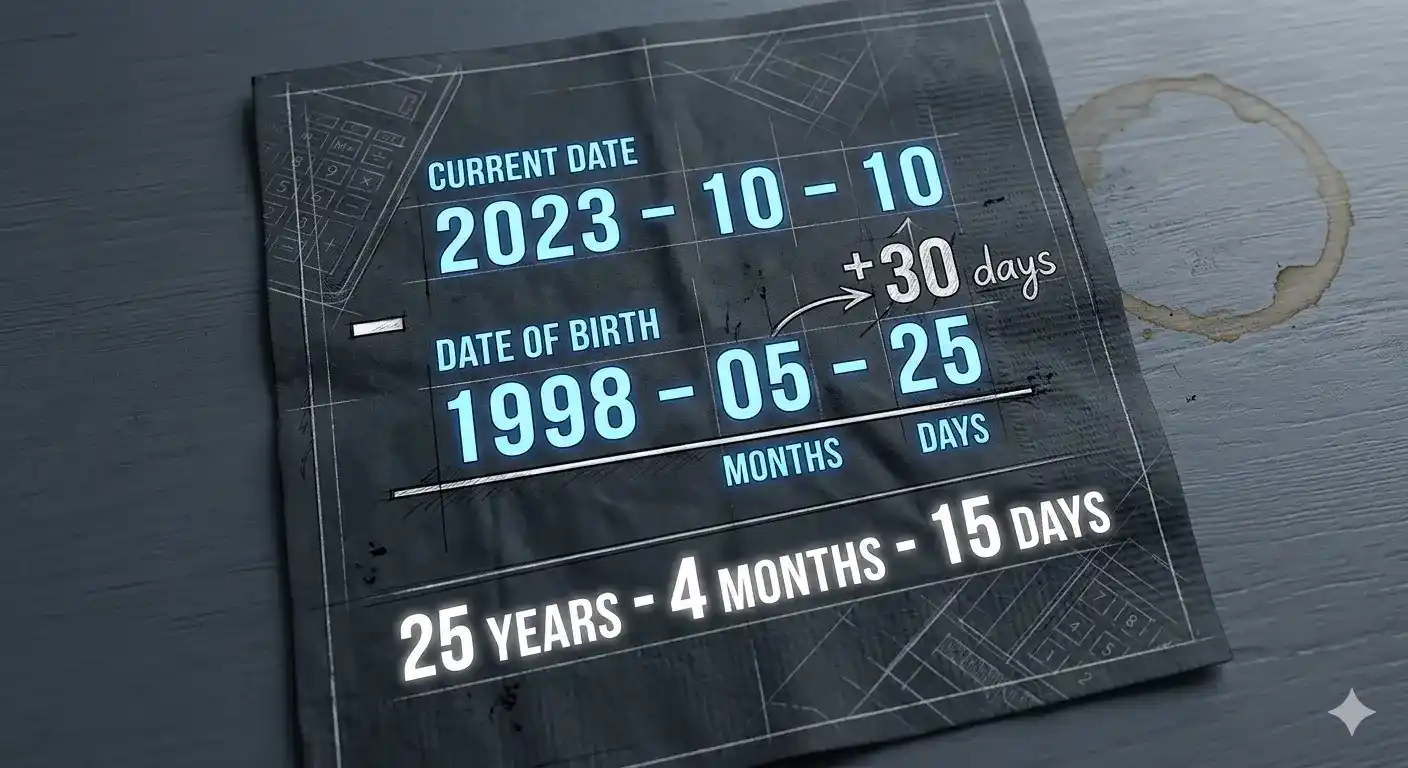
General Formula
Age = (Current Date − Birth Date) adjusted for calendar rules
How to Calculate Age in Excel Using DATEDIF
Microsoft Excel has a built-in function called DATEDIF that calculates the difference between two dates. It is the most accurate way to get age in Excel without manual math.
// Years only
=DATEDIF(A1, TODAY(), "Y")
// Full breakdown: years, months, days
=DATEDIF(A1,TODAY(),"Y")&" Years, "&DATEDIF(A1,TODAY(),"YM")&" Months, "&DATEDIF(A1,TODAY(),"MD")&" Days"
Where A1 contains the date of birth (e.g., 01/01/1990) and TODAY() returns today's date automatically. Use "YM" for remaining months and "MD" for remaining days within the current month.
How Many Days Have I Been Alive?
Your total days lived is calculated by counting every single calendar day from your birth date up to today, including all leap year days. This gives a precise measure of your lifetime in days rather than rounded years.
A simple estimate like years × 365 is not accurate because some years contain 366 days. A correct calculation adds one extra day for each leap year that occurred during your lifetime. For a person born in 1990, that means approximately 8–9 extra days by their 35th birthday.

Days Lived Formula
Total Days = (Years × 365) + Leap Days + Remaining Days in Current Year
| Milestone | Age | Approx Days | Leap Years |
|---|---|---|---|
| First Birthday | 1 year | 365–366 | 0–1 |
| Adulthood | 18 years | 6,574 | 4 |
| 25 Years | 25 years | 9,131 | 6 |
| 10,000 Days Alive | ≈ 27.4 years | 10,000 | ≈ 7 |
| 30 Years | 30 years | 10,957 | 7–8 |
| 50 Years | 50 years | 18,262 | 12 |
| 75 Years | 75 years | 27,394 | 18 |
| 100 Years | 100 years | 36,524 | 24 |
Values are approximate and may vary slightly depending on birth date and leap year distribution.
Tracking age in days is useful in medical, legal, and personal contexts where exact time measurement is required. Reaching 10,000 days alive is a popular milestone — it happens at approximately 27 years and 4 months old.
Why the Gregorian Calendar Makes Age Calculation Complex
The Gregorian calendar is based on the Earth's orbit around the Sun, which takes approximately 365.2422 days — not a clean 365 days. This fractional remainder is the reason leap years exist and why simple year-based calculations are never fully accurate.
A leap year is added roughly every 4 years to absorb this extra fraction. The rules are:
The 3-Rule Leap Year System
- A year is a leap year if it is divisible by 4 (e.g., 2024, 2028).
- Exception: Century years (1700, 1800, 1900) are not leap years even if divisible by 4.
- Exception to the exception: Century years divisible by 400 (e.g., 2000, 2400) are leap years.
What Happens If You Were Born on February 29?
People born on February 29 (a leap day) are called leaplings or leap year babies. Their birthday only appears on the calendar every 4 years, so their chronological age is calculated normally — but the birthday celebration falls on either February 28 or March 1 in non-leap years.
Legally, most countries recognize February 28 or March 1 as the official birthday in non-leap years, depending on local law. Our calculator handles February 29 birthdays accurately regardless of the current year.
Because of these irregularities, simple math like "years × 365" cannot give exact results. Accurate age calculation requires checking real calendar rules — which is why digital calculators like LizoCalc are more reliable than manual estimates.
How to Calculate Age from Date of Birth — Step by Step
You can calculate age manually by following these steps. This is the same logic that our calculator uses internally to ensure accuracy.
Write Down Both Dates
Note your birth date (day, month, year) and today's date. For example: Born April 15, 1995 — Today: April 24, 2026.
Subtract the Days
24 − 15 = 9 days. If today's day is smaller than the birth day, borrow days from the previous month (e.g., borrow 30 or 31 days).
Subtract the Months
April (4) − April (4) = 0 months. If the current month is smaller than the birth month, borrow 12 months from the year count.
Subtract the Years
2026 − 1995 = 31 years. Final answer: 31 years, 0 months, 9 days.
Verify with LizoCalc
Enter your dates into the LizoCalc Age Calculator above to confirm your manual calculation correctly accounts for leap years.
Age Calculation Standards Used in Different Countries
Age is not calculated identically everywhere. Three main systems exist worldwide, and understanding them is important when interpreting results across different cultural or legal contexts:
| System | Used In | How Age Increments | Key Difference |
|---|---|---|---|
| Gregorian (Western) | Most of the world | On each birthday | Age is 0 until first birthday |
| East Asian (Korean traditional) | Korea (traditional) | At birth (age 1) + Jan 1 each year | A baby born Dec 31 is "2" the next day |
| Chinese Nominal Age | Parts of China | At birth and Lunar New Year | Varies by lunar calendar alignment |
South Korea's Age System Reform (2023)
In June 2023, South Korea officially abolished its traditional age counting system by law. All official documents, medical records, and legal contexts now use the international (Gregorian) chronological age system. This means South Koreans are now legally 1–2 years younger on paper than they were under the old system.
Our calculator uses the standard Gregorian system — the internationally recognized legal standard used in government IDs, passports, academic records, and financial documents worldwide.
Corrected Age for Premature Babies (Medical Use Case)
Corrected age (also called adjusted age) is used in pediatrics for babies born before full term. It adjusts the child's chronological age based on how early they were born, giving a more accurate measure for tracking developmental milestones.
Corrected Age Formula
Corrected Age = Chronological Age − (40 weeks − Gestational Age at Birth)
For example, a baby born at 32 weeks (8 weeks early) who is now 6 months old has a corrected age of approximately 4 months. Doctors use this number — not 6 months — to assess whether the baby is meeting normal milestones for sitting, smiling, or motor skills.
Corrected age is typically used until a child reaches 2 to 3 years old, after which the difference between chronological and corrected age becomes less clinically significant.
This concept is widely used in pediatric healthcare and neonatal intensive care units (NICUs). It is separate from legal age or any official documentation system.
How Old Am I? — Age in Years, Months, Weeks, Days, Hours, and Seconds
Your age can be expressed in multiple units beyond just years. This is useful for medical record-keeping, personal curiosity, milestone tracking, and data analysis. Here is how each unit is derived:
| Unit | Calculation | Example (Age 30) |
|---|---|---|
| Years | Direct subtraction with borrowing method | 30 years |
| Months | Years × 12 + remaining months | ~360 months |
| Weeks | Total days ÷ 7 | ~1,565 weeks |
| Days | Count all days including leap days | ~10,957 days |
| Hours | Total days × 24 | ~262,968 hours |
| Minutes | Total hours × 60 | ~15,778,080 minutes |
| Seconds | Total minutes × 60 | ~946,684,800 seconds |
LizoCalc's age calculator provides all of these breakdowns instantly so you never have to compute them manually.
How Many Days Until My Next Birthday?
A birthday countdown calculator finds the exact number of days between today and your next birthday. It correctly handles year-end crossovers — for example, if your birthday is in January and today is in November, it counts forward into the next year.
Birthday Countdown Formula
Days Until Birthday = Next Birthday Date − Today's Date
If today is past the birthday this year, next birthday = same day/month in (current year + 1)
Our calculator also tells you the day of the week your next birthday falls on — useful for planning events, requesting time off, or simply satisfying curiosity.
What Day of the Week Was I Born?
You can determine the day of the week for any past date using the Zeller's Congruence algorithm or the Doomsday Algorithm. Both are mathematical methods that map any Gregorian date to a weekday. Our calculator runs this calculation automatically and displays the result alongside your age breakdown.
How Age Is Used in Real-World Contexts
Chronological age is referenced in virtually every important life event. Here are the most common real-world applications:
🎓 School Enrollment
Most countries determine school readiness based on whether a child turns a specific age (commonly 5 or 6) before a cutoff date in the calendar year. Age calculators help parents verify eligibility before registration deadlines.
🏛️ Legal & Government
Voting rights, driving licenses, legal contracts, alcohol purchase, and retirement pension all have age-based thresholds. Passports and national IDs are issued using date of birth as the primary identifier.
🏥 Healthcare & Medicine
Vaccine schedules, pediatric growth charts, cancer screening recommendations, and medication dosages are all calibrated to chronological age in years and months — sometimes to days for neonates.
💰 Financial Planning
Retirement calculators, pension eligibility, life insurance premiums, and investment horizon planning all depend on your exact current age and projected future age at specific milestones.
⚽ Sports & Athletics
Youth sports categories, Olympic eligibility, and age-group competitions are strictly governed by chronological age. A single day can determine which category an athlete competes in.
🐕 Pet Age Conversion
A common question is 'how old is my dog in human years?' The traditional rule of multiplying by 7 is inaccurate. Modern science suggests a logarithmic model, especially for the first two years of a dog's life.
Common Mistakes in Age Calculation (And How to Avoid Them)
Ignoring Leap Years
Fix: Always count actual calendar days rather than multiplying years by 365. Our calculator handles this automatically.
Forgetting the Borrowing Step
Fix: When the current day is less than the birth day, many people make arithmetic errors. Always borrow from the prior month before subtracting.
Using the Wrong Date Format
Fix: Confusing MM/DD/YYYY (US) with DD/MM/YYYY (international) can shift results by months. Always confirm your input format before calculating.
Not Accounting for Time Zones
Fix: For precise age-to-the-hour calculations, birth time and time zone matter. For daily calculations, the date alone is sufficient.
Mixing Age Systems
Fix: Applying Korean traditional age logic to a Gregorian date (or vice versa) produces results that differ by 1–2 years. Always specify which system you are using.
Written by Rana Muhammad Abdullah
MERN Stack Developer & Tool Maker · Mechatronics & Control Engineering Student · LinkedIn