⚡ Quick Answer: What is BMI?
BMI (Body Mass Index) is a simple calculation using height and weight to estimate body fat. The meaning of BMI is straightforward — it classifies individuals into underweight, normal, overweight, or obese categories using the formula weight (kg) ÷ height² (m²). A BMI between 18.5 and 24.9 is considered a normal, healthy BMI for most adults.
What is BMI? (Simple Meaning)
BMI stands for Body Mass Index. The body mass index meaning is simple: it is a single number that estimates how much body fat you are likely carrying based on your height and weight — without any blood tests, scans, or equipment.
Think of it this way: two people of the same height can weigh very different amounts. The BMI index captures that difference and maps it onto a scale that health professionals use to flag potential weight-related risks — from malnutrition at the lower end to obesity-related conditions at the higher end.
The concept was developed in the 1830s by Belgian mathematician Adolphe Quetelet and was formally adopted by the global medical community in the 1970s.[1] Today it remains the most widely used population-level screening tool worldwide — not because it is perfect, but because it is fast, free, and requires no specialist equipment.
What is a Normal BMI for Adults?
A normal BMI for adults is any value between 18.5 and 24.9 kg/m², according to the World Health Organization.[2] This is also referred to as a healthy BMI. Below 18.5 signals underweight, and 25 or above moves into overweight territory.
What is My BMI? — How to Find Out in 3 Steps
Finding out your own BMI takes under a minute:
- Measure your weight in kilograms (or pounds)
- Measure your height in metres (or inches)
- Divide weight by height squared — or use our BMI Calculator to get your result instantly
“Whats my bmi?” is one of the most searched health queries worldwide — the answer is always one calculation away.
BMI Formula — Metric and Imperial (kg/m²)
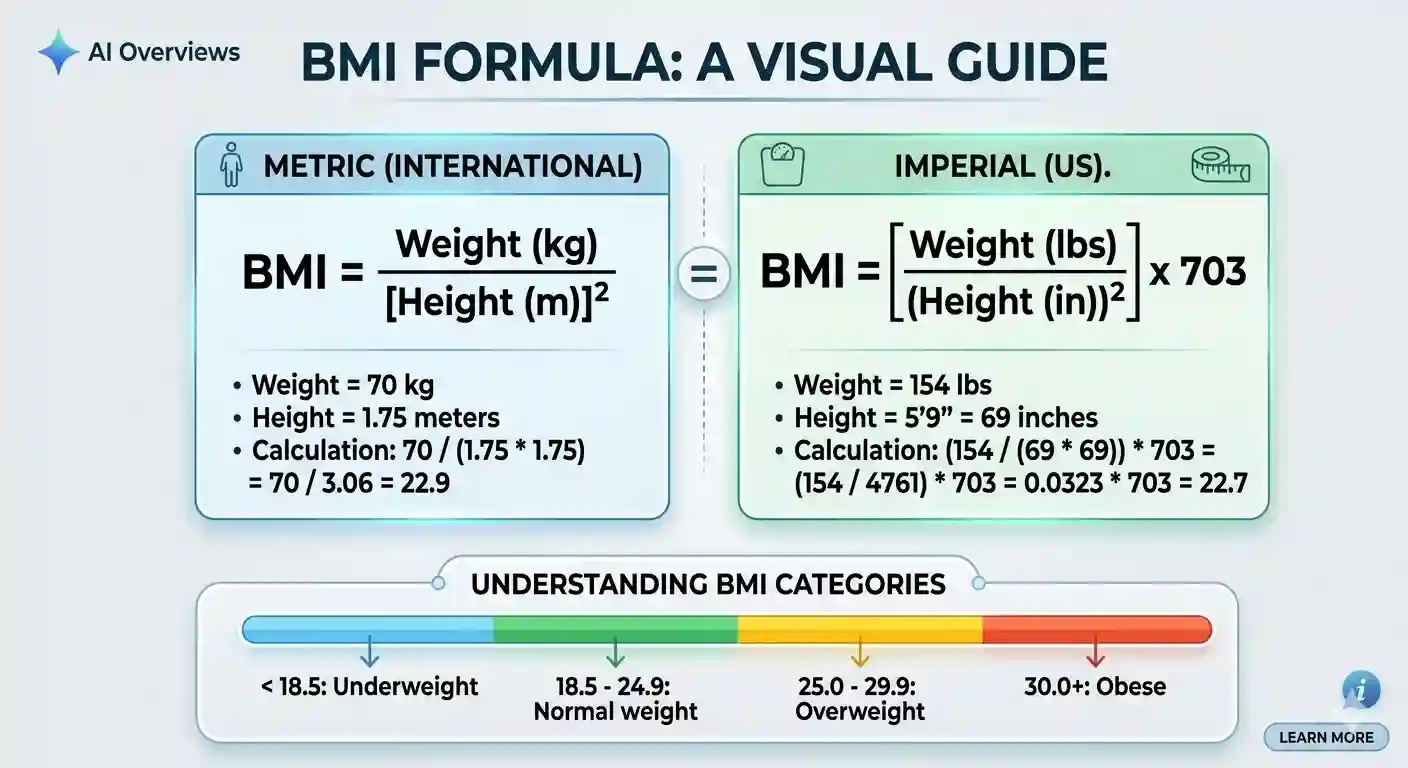
Metric Formula — BMI Formula kg/m²
Unit: kg/m²
The BMI formula kg/m² unit means you are dividing your mass in kilograms by the square of your height in metres. The resulting number has no physical unit in everyday use — you simply compare it to the category thresholds in the table below.[2]
Imperial Formula (pounds and inches)
The factor 703 converts the result to the same kg/m² scale
Both formulas produce an equivalent result. If you are entering pounds and feet, convert feet to total inches first (e.g., 5 ft 9 in = 69 inches total).
BMI Categories — Standard Range Table
What is a Healthy BMI? — WHO Standard Ranges
The World Health Organization defines the following BMI ranges for adults aged 18 and above.[2] These thresholds apply to both men and women:
| Category | BMI Range (kg/m²) | Health Signal |
|---|---|---|
| Underweight | Below 18.5 | Possible nutrient deficiency, low bone density |
| Normal weight | 18.5 – 24.9 | Generally healthy range for most adults |
| Overweight | 25.0 – 29.9 | Elevated risk of heart disease, type 2 diabetes |
| Obese (Class I) | 30.0 – 34.9 | Significantly higher chronic disease risk |
| Obese (Class II) | 35.0 – 39.9 | High risk; medical guidance strongly recommended |
| Obese (Class III) | 40.0 and above | Very high risk; also called severe or morbid obesity |
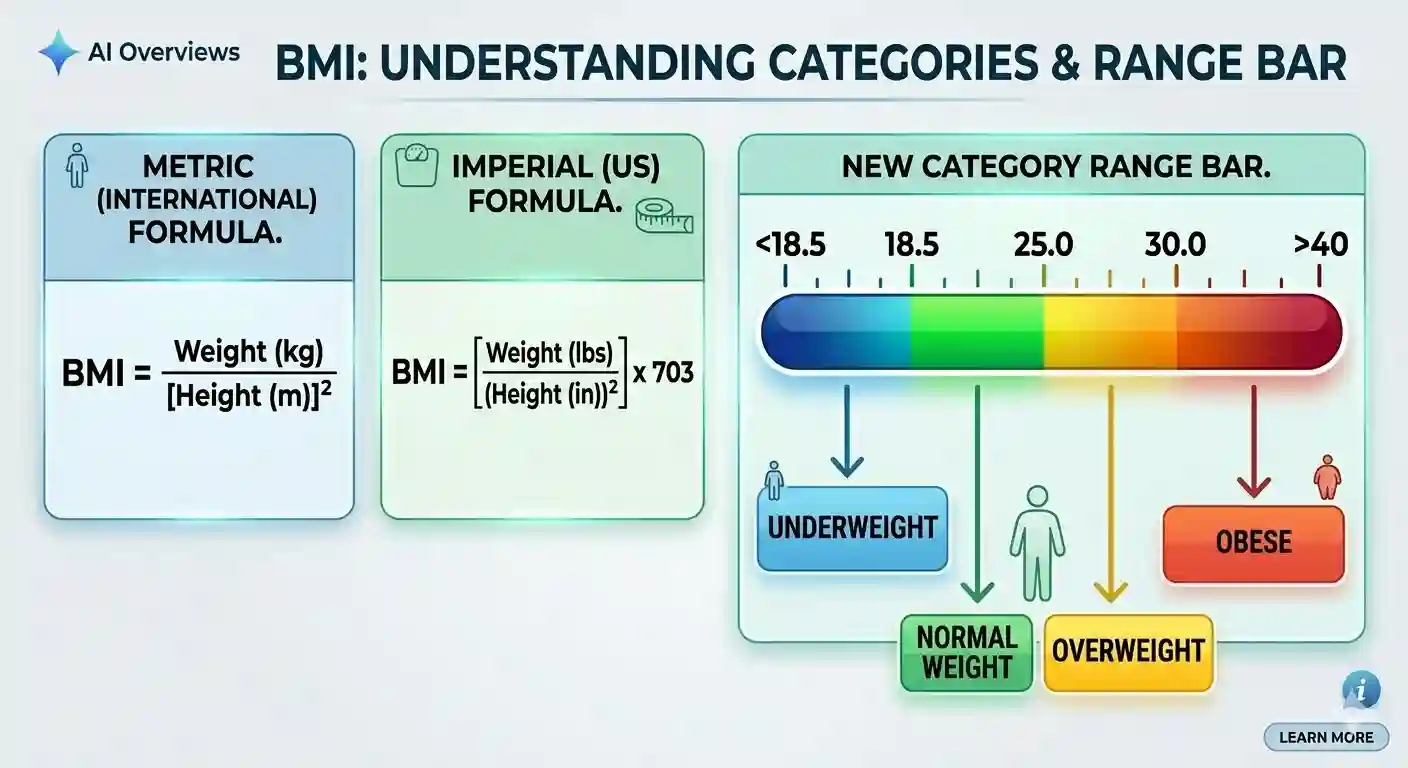
Note: The WHO Expert Consultation on Obesity proposed adjusted action thresholds of 23.0 (overweight) and 27.5 (obese) for Asian populations, including South Asians.[3] Speak to your doctor about which thresholds apply to you.
BMI Example Calculation — Step by Step
Most health blogs show the formula and nothing else. Here are two complete worked examples — metric and imperial — so you can follow every step with your own numbers.
Metric Example (kg and metres)
Person: Weight = 70 kg, Height = 1.75 m
1.75 × 1.75 = 3.0625 m²
Step 2 — Divide weight by that result
70 ÷ 3.0625 = 22.86 kg/m²
Result: BMI = 22.86 → Normal weight ✓
Imperial Example (lbs and inches)
Person: Weight = 154 lbs, Height = 5 ft 9 in (= 69 inches total)
69 × 69 = 4,761 inches²
Step 2 — Multiply weight by 703
154 × 703 = 108,262
Step 3 — Divide
108,262 ÷ 4,761 = 22.74 kg/m²
Result: BMI ≈ 22.74 → Normal weight ✓
You do not need to do this manually every time. Use our BMI Calculator to get your result in seconds — metric or imperial, with your category shown instantly.
BMI for Men vs Women — Same Number, Different Meaning
The BMI formula and category thresholds are identical for men and women. However, the same BMI value does not always indicate the same level of health risk between the sexes — because fat distribution differs significantly between males and females.[4]
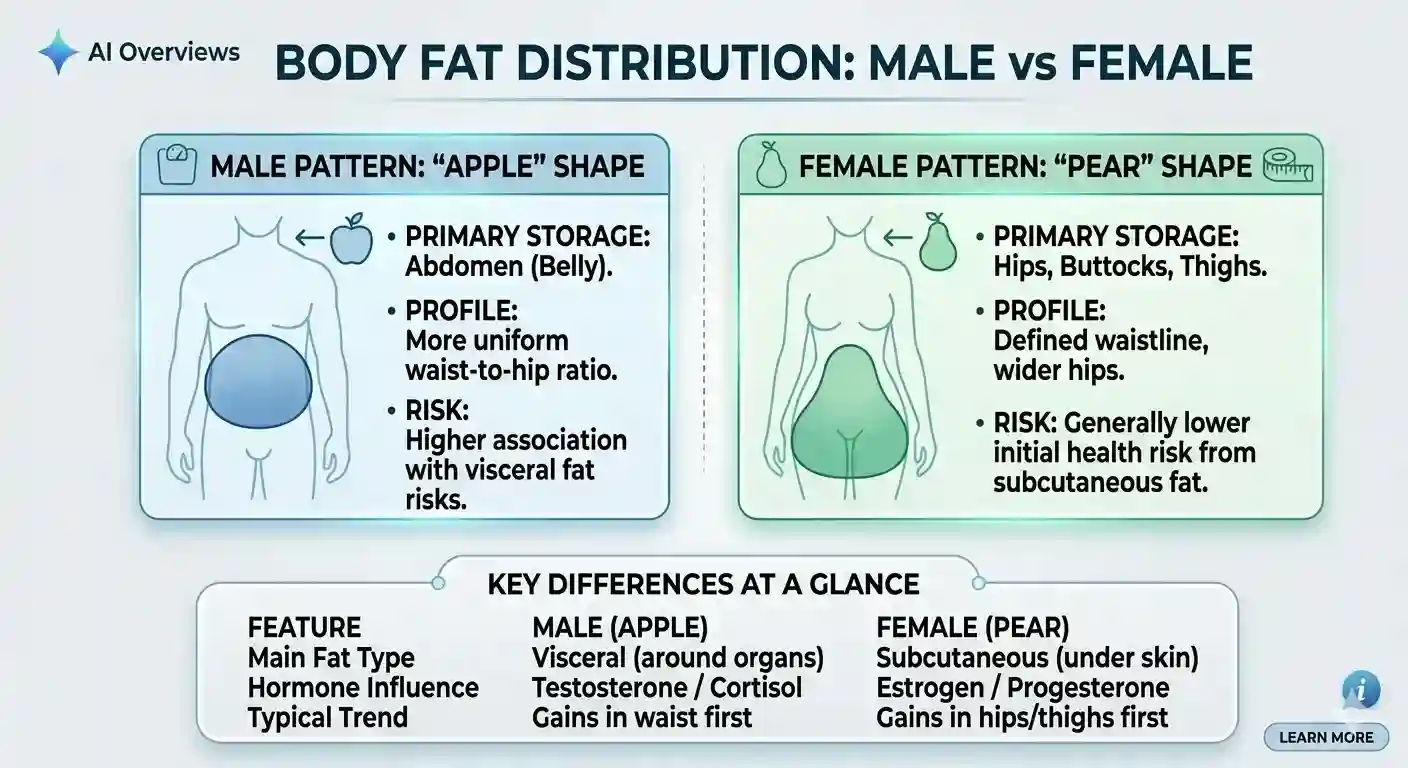
Women — Pear Shape
- Naturally carry 6–11% more body fat than men
- Higher fat partly due to estrogen and progesterone
- Fat stored primarily on hips, buttocks, and thighs
- Subcutaneous (under-skin) fat is metabolically less harmful
- A BMI of 22 in a woman may mean a higher fat percentage than a man at the same BMI
Men — Apple Shape
- Generally carry more muscle mass at the same BMI
- More prone to visceral (abdominal) fat accumulation
- Visceral fat increases heart disease and diabetes risk
- A muscular man may show overweight BMI with very low fat
- Waist circumference adds critical context beyond BMI alone
The key takeaway: two people with an identical BMI of 27 can have completely different health profiles depending on their sex, muscle mass, and where their fat is stored. The BMI index is a starting point — not the full picture.
BMI by Age — Adults vs Children
Adults (18 and over)
The standard WHO BMI thresholds apply to adults aged 18 and above. For most adults, these ranges are consistent across age groups, though older adults (65+) may face a different risk profile because muscle mass naturally declines with age — a process called sarcopenia.[5] An elderly person with a “normal” BMI may actually have too little muscle and too much fat.
Children and Teenagers (2–19 years)
For children and teens, BMI is calculated with the same formula but interpreted using age- and sex-specific growth charts to produce a BMI percentile — not a fixed category.[6]
| BMI Percentile (Children/Teens) | Category |
|---|---|
| Below 5th percentile | Underweight |
| 5th to below 85th percentile | Healthy weight |
| 85th to below 95th percentile | Overweight |
| 95th percentile and above | Obese |
Never use the adult BMI table for a child. Normal BMI ranges shift significantly between ages 2 and 19 — a 7-year-old and a 16-year-old with the same BMI number are in completely different health categories.
Limitations of BMI — What It Cannot Tell You
This section is what most health blogs skip — and it is arguably the most important part. BMI vs body fat is not the same measurement. BMI has real, well-documented limitations that every user should understand before acting on their result.
1. It does not distinguish fat from muscle
A professional rugby player or bodybuilder can have a BMI of 28–30 and be classified as “overweight” despite very low body fat. Muscle is denser and heavier than fat. BMI sees only total weight — it cannot differentiate between 10 kg of fat and 10 kg of muscle.[7]
2. It ignores fat distribution
Two people with an identical BMI of 26 can have completely different health risks depending on where their fat sits. Visceral fat around the abdominal organs is far more dangerous than subcutaneous fat on the hips and thighs. BMI does not tell you which type you have.
3. Less accurate for older adults
As people age, muscle mass decreases and body fat tends to increase even if weight stays the same. An elderly person may have a “normal” BMI while actually having too much fat and too little muscle, increasing fall risk and metabolic problems.[5]
4. Not calibrated for every ethnicity — especially South Asians
The standard WHO thresholds were developed primarily from European populations. Research published in The Lancet shows that South Asians — including Pakistanis and Indians — tend to develop metabolic diseases at lower BMI values than Europeans.[3] The WHO Expert Consultation recommends adjusted action points of 23.0 (overweight) and 27.5 (obese) for Asian populations.
5. Does not apply during pregnancy
BMI is not a valid measure during pregnancy. Weight gain is expected and healthy during gestation. Standard BMI categories do not apply, and separate pregnancy weight gain guidelines exist based on pre-pregnancy BMI.
Better Alternatives to BMI
If BMI vs body fat measurement is the real goal, here are four options that provide more complete information — and that most people can measure at home:
Waist Circumference
Measures abdominal fat directly. Measure at the narrowest point of your torso, just above the belly button.
Risk threshold: >94 cm (men) / >80 cm (women)[2]
Waist-to-Hip Ratio (WHR)
Divide your waist measurement by your hip measurement. A higher ratio signals more abdominal fat and greater cardiovascular risk.
High risk: >1.0 (men) / >0.85 (women)
Body Fat Percentage
The most direct measure of fatness. Measured via DEXA scan, hydrostatic weighing, or smart scales. Unlike BMI, it distinguishes fat from muscle entirely.
Healthy range: 10–20% (men) / 18–28% (women)
Waist-to-Height Ratio
Divide your waist measurement by your height. Research suggests this is a stronger predictor of cardiometabolic risk than BMI, particularly across different ethnicities.
Healthy: keep waist below half your height
The best approach is to use BMI as one data point alongside waist circumference and waist-to-hip ratio — not as a standalone health verdict.
When BMI is Actually Useful
Given its limitations, should you bother with BMI at all? Yes — in the right context, it remains a practical and widely accepted tool:
- ✓General health screening: Doctors use BMI as a first-pass filter to identify patients who may benefit from further testing. It is fast, requires no lab work, and gives a rough baseline in under a minute.
- ✓Population-level research: Public health agencies use BMI to track obesity trends across populations and regions over time. For this aggregate purpose, individual inaccuracies largely average out.[1]
- ✓Tracking personal change over time: Even if your absolute BMI number is imperfect, tracking the direction of change over months can signal whether a diet or fitness plan is producing results.
- ✓Clinical and insurance eligibility: Many clinical programmes, insurance products, and bariatric procedures use BMI thresholds as eligibility criteria — so knowing your number has practical administrative value.
Calculate Your BMI Now — Free Tool
Now that you understand what BMI means, how to calculate bmi manually, and where its limits lie — check your own number using our free tool. It works in both metric and imperial, shows your WHO category instantly, and requires no sign-up.
Open BMI Calculator →Free · No sign-up · Works on mobile · Metric & imperial · Result in under 1 seconds
References & Sources
This article is based on peer-reviewed research and guidelines from internationally recognised health organisations. All sources were accessed in April 2026.
- Keys A, Fidanza F, Karvonen MJ, Kimura N, Taylor HL. Indices of relative weight and obesity. Journal of Chronic Diseases. 1972;25(6):329–343. — Original paper establishing BMI as a population screening measure.
- World Health Organization. BMI Classification — Global Database on Body Mass Index. Geneva: WHO; 2004. Available at: who.int. — Source for all BMI category thresholds (18.5, 25.0, 30.0).
- WHO Expert Consultation. Appropriate body-mass index for Asian populations and its implications for policy and intervention strategies. The Lancet. 2004;363(9403):157–163. DOI: 10.1016/S0140-6736(03)15268-3. — Source for adjusted Asian BMI thresholds (23.0 overweight, 27.5 obese).
- Centers for Disease Control and Prevention (CDC). Body Mass Index: Considerations for Practitioners. Atlanta: CDC; 2011. Available at: cdc.gov. — Source for sex-based differences in BMI and fat distribution.
- Cruz-Jentoft AJ, Baeyens JP, Bauer JM, et al. Sarcopenia: European consensus on definition and diagnosis. Age and Ageing. 2010;39(4):412–423. — Source for age-related muscle decline and BMI accuracy in older adults.
- Centers for Disease Control and Prevention (CDC). BMI for Children and Teens. Available at: cdc.gov. — Source for children's BMI percentile system (ages 2–19).
- Nevill AM, Stewart AD, Olds T, Holder R. Relationship between adiposity and body size reveals limitations of BMI. American Journal of Physical Anthropology. 2006;129(1):151–156. — Source for BMI limitations regarding muscle mass vs fat mass.
Written by Rana Muhammad Abdullah
MERN Stack Developer & Tool Maker · Mechatronics & Control Engineering Student · LinkedIn
Content based on WHO guidelines, CDC recommendations, and peer-reviewed research. See full references above.
BMI is not a verdict — it is a starting point. Use it alongside other measurements, understand its limits, and always consult a healthcare professional for personal medical decisions.