⚡ Quick Answer: How to Calculate BMI
BMI is calculated by dividing your weight in kilograms by the square of your height in meters: BMI = weight (kg) ÷ height (m)². A healthy BMI range for most adults is 18.5 – 24.9. Below 18.5 is underweight; 25–29.9 is overweight; 30 and above is obese. BMI estimates body fat based on height and weight, but it does not directly measure body fat percentage.
What Is BMI (Body Mass Index)?
Body Mass Index (BMI) is a numerical value derived from a person's height and weight that serves as a proxy indicator of body fatness and associated health risk. The concept was developed by Belgian mathematician Adolphe Quetelet in the 1830s — which is why it was originally called the Quetelet Index — and was formally adopted as a clinical screening tool by the World Health Organization (WHO) and the U.S. National Institutes of Health (NIH) in the 1990s.
Doctors and public health professionals use BMI primarily because it is inexpensive, non-invasive, and reproducible at scale. A single BMI calculation can flag whether a patient warrants further investigation for conditions such as type 2 diabetes, cardiovascular disease, hypertension, sleep apnea, or malnutrition — making it an indispensable first step in a clinical encounter.
Important trust statement: BMI estimates body fat based on height and weight, but it does not directly measure body fat percentage. It is a screening tool, not a medical diagnosis. Always consult a qualified healthcare professional for a full health assessment.
In Pakistan, the Pakistan Society of Endocrinology and Metabolism and local public health bodies recognise BMI as the standard first-line screening metric for weight-related risk. However, because South Asian populations — including Pakistanis — tend to accumulate visceral fat at lower BMI values than Western populations, adjusted thresholds of 23 (overweight) and 27.5 (obese) are increasingly used alongside the global WHO ranges.
How to Calculate BMI — The Exact Formula
Metric BMI Formula (kg and cm)
The standard metric formula — used in Pakistan, the UK, Europe, and most of the world — is:
Example: Weight = 70 kg, Height = 175 cm (1.75 m)
BMI = 70 ÷ (1.75 × 1.75)
BMI = 70 ÷ 3.0625
→ BMI = 22.86 — Healthy Weight ✅
Note that height must be converted from centimetres to metres before squaring. 175 cm ÷ 100 = 1.75 m. Our calculator handles this conversion automatically.
Imperial BMI Formula (lbs and inches)
For users working in pounds and inches (common in the US), the formula includes a correction factor of 703:
Example: Weight = 154 lbs, Height = 5'9" = 69 inches
BMI = (154 × 703) ÷ (69 × 69)
BMI = 108,262 ÷ 4,761
→ BMI = 22.74 — Healthy Weight ✅
Common BMI Examples by Weight and Height
Below are manually calculated BMI values for the most commonly searched height-and-weight combinations:
| Weight | Height | BMI | Category | Calculation |
|---|---|---|---|---|
| 70 kg | 170 cm | 24.22 | ✅ Healthy Weight | 70 ÷ 1.70² |
| 80 kg | 180 cm | 24.69 | ✅ Healthy Weight | 80 ÷ 1.80² |
| 90 kg | 183 cm (6'0") | 26.87 | ⚠️ Overweight | 90 ÷ 1.83² |
| 60 kg | 167 cm (5'6") | 21.51 | ✅ Healthy Weight | 60 ÷ 1.67² |
| 150 lbs | 5'7" (67 in) | 23.49 | ✅ Healthy Weight | (150×703)÷67² |
| 100 kg | 175 cm | 32.65 | ❌ Obese Class I | 100 ÷ 1.75² |
| 50 kg | 165 cm | 18.37 | ⬇️ Underweight | 50 ÷ 1.65² |
BMI Chart and Weight Categories — WHO Standard
The World Health Organisation (WHO) defines five adult BMI weight categories. Each range is associated with a different level of health risk. Knowing which category your BMI falls into is the first step toward setting a targeted, realistic health goal:
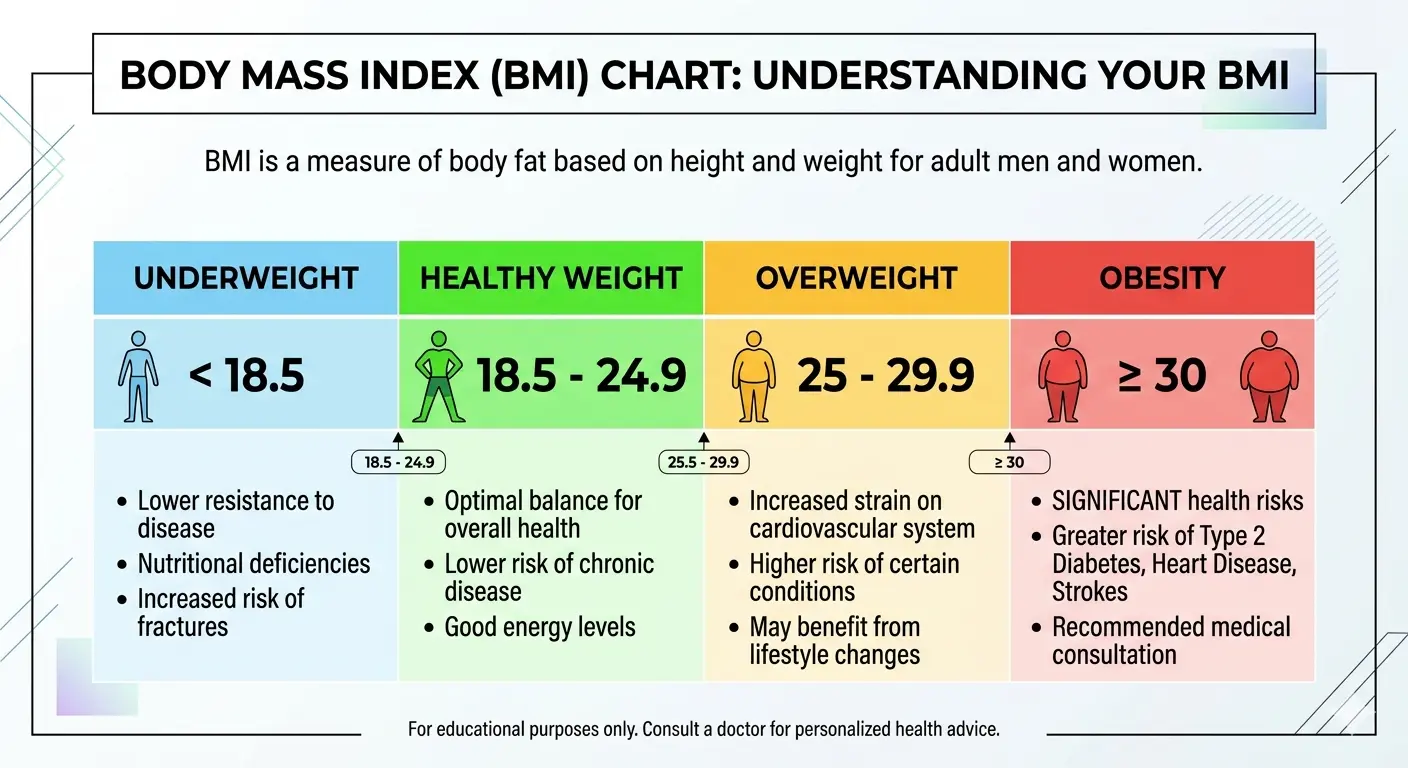
The BMI scale above illustrates how weight categories progress from Underweight through to Obesity Class III. Each colour band represents a different zone of health risk — with the green band (18.5–24.9) indicating the range associated with the lowest risk of weight-related disease for most adults.
| BMI Range | WHO Category | South Asian Adjusted | Health Risk Level |
|---|---|---|---|
| Below 18.5 | Underweight | Below 18.5 | Moderate (malnutrition risk) |
| 18.5 – 24.9 | ✅ Healthy Weight | 18.5 – 22.9 | Lowest risk |
| 25.0 – 29.9 | ⚠️ Overweight | 23.0 – 27.4 | Increased risk |
| 30.0 – 34.9 | Obesity Class I | 27.5 – 32.4 | High risk |
| 35.0 – 39.9 | Obesity Class II | 32.5 – 37.4 | Very high risk |
| 40 and above | Obesity Class III | 37.5+ | Extremely high risk |
BMI Chart by Height and Weight — Quick Reference
The table below shows pre-calculated BMI values for common height and weight combinations — one of the most-searched formats for BMI reference. Use this to instantly find your approximate BMI without any calculation, then use the tool above for a precise figure:
| Height | 50 kg / 110 lbs | 60 kg / 132 lbs | 70 kg / 154 lbs | 80 kg / 176 lbs | 90 kg / 198 lbs | 100 kg / 220 lbs |
|---|---|---|---|---|---|---|
| 155 cm / 5'1" | 20.8 | 25.0 | 29.1 | 33.3 | 37.5 | 41.6 |
| 160 cm / 5'3" | 19.5 | 23.4 | 27.3 | 31.3 | 35.2 | 39.1 |
| 165 cm / 5'5" | 18.4 | 22.0 | 25.7 | 29.4 | 33.1 | 36.7 |
| 170 cm / 5'7" | 17.3 | 20.8 | 24.2 | 27.7 | 31.1 | 34.6 |
| 175 cm / 5'9" | 16.3 | 19.6 | 22.9 | 26.1 | 29.4 | 32.7 |
| 180 cm / 5'11" | 15.4 | 18.5 | 21.6 | 24.7 | 27.8 | 30.9 |
| 183 cm / 6'0" | 14.9 | 17.9 | 20.9 | 23.9 | 26.9 | 29.9 |
Colour key: Blue = Underweight · Green = Healthy Weight · Yellow = Overweight · Orange = Obese Class I · Red = Obese Class II · Dark Red = Obese Class III
Healthy Weight Range for Your Height — Ideal Weight Chart
The table below shows the healthy weight range for common heights — calculated as the weights that produce a BMI of 18.5 to 24.9. Use this as your ideal weight chart to set realistic, science-backed weight goals. The calculator above also displays your personal healthy range the moment you enter your height:
| Height | Healthy Weight Range (kg) | Healthy Weight Range (lbs) | BMI Range |
|---|---|---|---|
| 152 cm / 5'0" | 43 – 58 kg | 95 – 128 lbs | 18.5 – 24.9 |
| 157 cm / 5'2" | 46 – 61 kg | 101 – 135 lbs | 18.5 – 24.9 |
| 165 cm / 5'5" | 50 – 67 kg | 111 – 149 lbs | 18.5 – 24.9 |
| 170 cm / 5'7" | 53 – 72 kg | 117 – 159 lbs | 18.5 – 24.9 |
| 175 cm / 5'9" | 57 – 76 kg | 125 – 168 lbs | 18.5 – 24.9 |
| 178 cm / 5'10" | 59 – 79 kg | 130 – 174 lbs | 18.5 – 24.9 |
| 183 cm / 6'0" | 62 – 84 kg | 137 – 184 lbs | 18.5 – 24.9 |
| 188 cm / 6'2" | 65 – 88 kg | 144 – 194 lbs | 18.5 – 24.9 |
BMI Limitations: When BMI Is Not Accurate
BMI is a valuable screening tool, but it has well-documented limitations for specific populations. Understanding these nuances is what separates a reliable health resource from a simplistic one:
🏋️ Athletes and Bodybuilders
Highly muscular individuals — such as rugby players, powerlifters, and competitive bodybuilders — may register as overweight or obese on the BMI scale despite having very low body fat percentages. Muscle is significantly denser than fat, so BMI overestimates health risk in this group.
🤰 Pregnancy
BMI is not a valid measure during pregnancy due to natural and necessary weight gain. Pregnant women should use pregnancy-specific weight gain guidelines provided by their obstetrician rather than standard BMI categories.
👴 Older Adults
Elderly individuals tend to lose muscle mass (sarcopenia) while retaining or gaining fat — a process called "sarcopenic obesity." This means a person in their 70s or 80s can have a normal BMI while carrying a dangerously high proportion of body fat.
👧 Children and Teenagers
Standard adult BMI categories do not apply to children or adolescents. For those under 18, healthcare providers use BMI-for-age percentiles, which account for normal growth patterns across different ages and biological sexes, as defined by the WHO Child Growth Standards.
🌍 Ethnicity and South Asians
South Asian populations — including Pakistanis, Indians, and Bangladeshis — have been shown to develop metabolic complications like insulin resistance and cardiovascular disease at lower BMI values than Western populations. Adjusted thresholds of 23.0 for overweight and 27.5 for obese are recommended by several major health bodies for South Asian adults.
📏 Fat Distribution
BMI does not indicate where fat is stored in the body. Visceral fat (stored around internal organs in the abdomen) is far more metabolically harmful than subcutaneous fat (stored under the skin). Waist circumference — above 90 cm for Asian men and 80 cm for Asian women — is a better predictor of cardiometabolic risk than BMI alone.
BMI for Adults, Men, Women, and Children
BMI for Adults — Universal Ranges
For all adults aged 18 and over, the WHO applies the same BMI classification table regardless of age or sex. The five categories (Underweight, Healthy Weight, Overweight, Obesity Class I–III) remain constant. However, the clinical interpretation of BMI should always consider individual factors such as muscle mass, ethnicity, and waist circumference.
BMI for Men and Women — How They Differ
While the BMI formula and category thresholds are the same for adult men and women, body composition differs significantly between the sexes:
- Men naturally carry more muscle mass and less body fat. A man at BMI 22 might have 15–20% body fat, which is within the athletic to normal range.
- Women naturally carry a higher proportion of body fat — typically 10–13% more than men — due to hormonal differences and reproductive physiology. A woman at BMI 22 might have 25–30% body fat, still within the normal range for females but much higher than an equivalent male.
- During menopause, women often experience a redistribution of fat toward the abdominal area, increasing cardiometabolic risk even without significant BMI change.
BMI for Kids and Teens — Age and Sex Percentiles
For children and adolescents under 18, BMI is interpreted using age- and sex-specific percentile charts, not the fixed adult thresholds. The WHO and CDC define the following percentile-based categories for children:
| BMI Percentile Range | Category (Children 2–18) |
|---|---|
| Below the 5th percentile | Underweight |
| 5th to less than the 85th percentile | ✅ Healthy Weight |
| 85th to less than the 95th percentile | ⚠️ Overweight |
| 95th percentile and above | Obese |
Paediatricians in Pakistan and worldwide use WHO Child Growth Standard charts to plot a child's BMI against these percentiles, accounting for both age and biological sex. If you are concerned about a child's BMI, always consult a qualified paediatrician.
How to Improve Your BMI Safely
Medical disclaimer: The following is general wellness information, not medical advice. Always consult a qualified doctor or dietitian before making significant changes to your diet or exercise routine, especially if you have an existing health condition.
If You Are Underweight (BMI Below 18.5)
- Calorie surplus: Aim to eat 300–500 calories more than your TDEE per day using nutrient-dense whole foods.
- Protein priority: Consume 1.6–2.2 g of protein per kg of body weight to support lean muscle building.
- Resistance training: Weight training 3–4 times per week directs surplus calories into muscle rather than fat storage.
- Frequent meals: Eating 5–6 smaller, calorie-dense meals makes it easier to reach daily calorie goals without discomfort.
If You Are Overweight or Obese (BMI 25+)
- Moderate calorie deficit: A deficit of 300–500 kcal/day produces safe, sustainable fat loss of 0.3–0.5 kg per week without metabolic adaptation.
- Mixed exercise: Combine 150 minutes of moderate cardio (walking, cycling) per week with 2–3 resistance training sessions.
- Sleep quality: Poor sleep raises cortisol and ghrelin (hunger hormone), making fat loss much harder. Aim for 7–9 hours.
- Hydration and protein: High protein intake (1.2–1.6 g/kg) preserves muscle during a deficit. Staying well-hydrated also reduces false hunger signals.
For a precise daily calorie target based on your activity level, use our TDEE Calculator to find your Total Daily Energy Expenditure, and our BMR Calculator to find the minimum calories your body needs at complete rest.
Written by Rana Muhammad Abdullah
MERN Stack Developer & Tool Maker · Mechatronics & Control Engineering Student · LinkedIn
Explore More Health and Fitness Tools
Find Your Resting Calorie Burn (BMR)
Discover exactly how many calories your body burns at complete rest using the Mifflin-St Jeor equation — the most accurate modern formula.
Open BMR Calculator →Estimate Your Body Fat Percentage
Go beyond BMI with the Navy tape measurement method — a far more actionable indicator of real body composition than weight alone.
Open Body Fat Calculator →Calculate Your Activity-Based Calorie Needs (TDEE)
Turn your BMR into a real-world daily calorie target by factoring in your activity level — essential for any weight management plan.
Open TDEE Calculator →Knowing your BMI is the first step — but it is just the beginning. Pair it with your BMR, body fat percentage, and TDEE to build a complete, data-driven picture of your health. Our free tools are fast, accurate, completely private, and built for real people in Sahiwal, across Pakistan, and around the world. Bookmark this page and take control of your health — one precise calculation at a time!