⚡ Quick Answer: What Is BMR?
BMR (Basal Metabolic Rate) is the number of calories your body needs daily to maintain basic life functions — breathing, circulation, cell repair, and temperature regulation — while at complete rest. For most adults, BMR accounts for 60–70% of total daily calorie burn. Use the Mifflin-St Jeor formula: Men: BMR = 10W + 6.25H − 5A + 5 · Women: BMR = 10W + 6.25H − 5A − 161 (W = weight kg, H = height cm, A = age years).
The Basal Metabolic Rate (BMR) — also called resting metabolic rate, resting calorie burn, or metabolic baseline — is the single most important number for anyone serious about managing their weight, planning their nutrition, or understanding how their body uses energy. Your BMR is the number of calories your body burns every 24 hours simply to stay alive: heart pumping, lungs breathing, kidneys filtering, brain functioning — all while you lie completely still.
Our completely free, no-registration-required BMR calculator uses the gold-standard Mifflin-St Jeor equation to deliver your precise daily, monthly, and yearly resting calorie estimates in seconds. Simply select your gender, slide your age, weight, and height, and get instant live results. Mobile-friendly, ad-free, 100% private, and built with metric units perfectly suited for Pakistan. Whether you are planning your diet in Sahiwal, tracking calories for a fitness goal, or using it in a nutrition class — this is the tool. Jump right in and try it now on our BMR calculator page.
What Is BMR (Basal Metabolic Rate)?
Basal Metabolic Rate (BMR) is the minimum number of calories your body burns per day to sustain essential life processes while in a state of complete rest — no movement, no food digestion, no exercise. It represents the energy cost of simply being alive: keeping your heart beating, lungs breathing, maintaining body temperature, producing hormones, repairing cells, and powering your brain.
For most adults, BMR accounts for approximately 60–70% of total daily energy expenditure — making it by far the largest single component of calorie burn, even for people who exercise regularly. This means your body burns the majority of its daily calories before you even get out of bed.
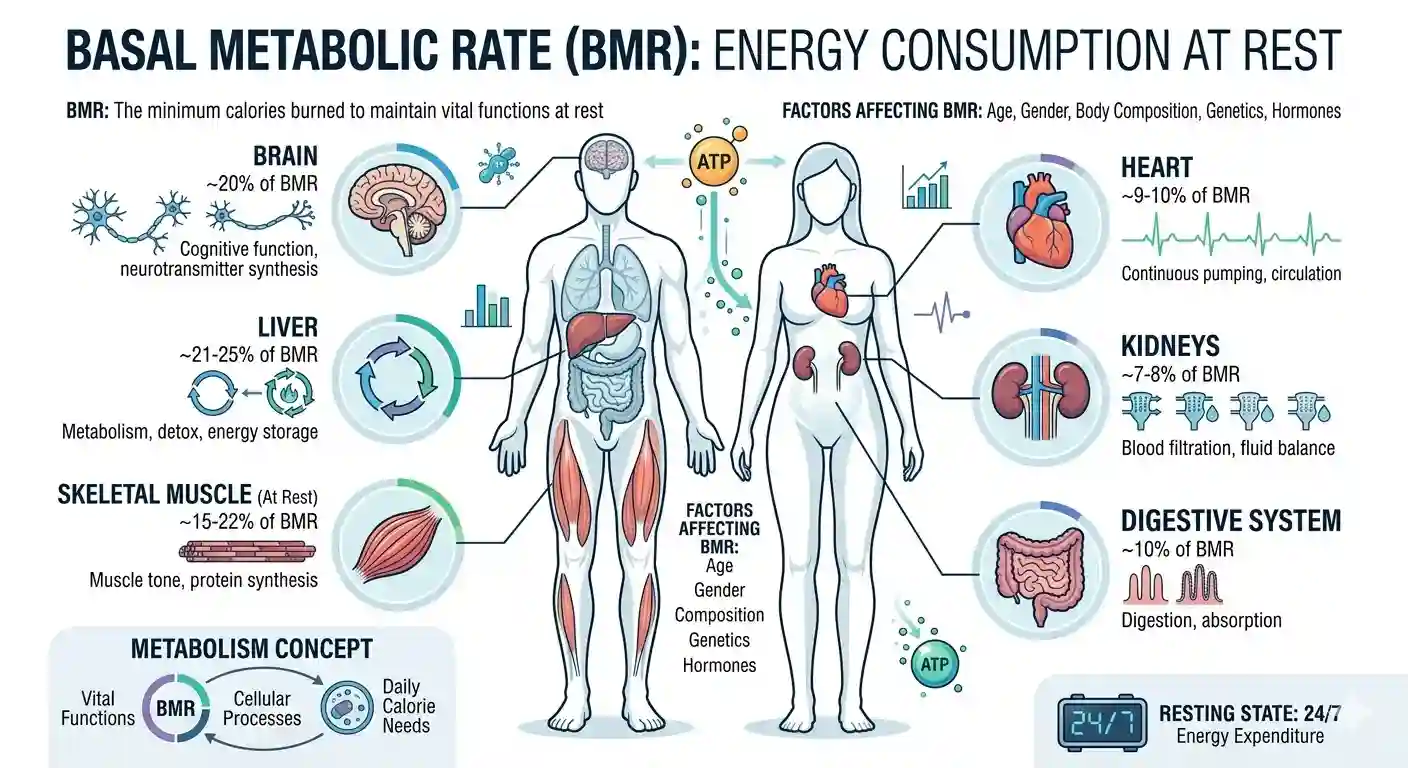
The infographic above shows exactly how your resting calories are distributed across organ systems. Your liver alone consumes 21–25% of your BMR — running metabolism, detox, and energy storage around the clock. The brain takes another 20%. Together with the heart, kidneys, digestive system, and skeletal muscle, these organs account for your entire resting energy expenditure — 24 hours a day, 7 days a week, even while you sleep.
The five key factors affecting BMR are: age, gender, body composition, genetics, and hormones — all captured by the Mifflin-St Jeor formula used in this calculator.
Key insight: Your body burns calories even while you are sleeping — this is your BMR at work. A person with a BMR of 1,700 cal/day burns roughly 70 calories per hour doing absolutely nothing. Understanding this number is the foundation of every evidence-based nutrition and weight management plan.
BMR Formula — The Mifflin-St Jeor Equation Explained
Our calculator uses the Mifflin-St Jeor equation — the most accurate and widely validated BMR formula available today, recommended by major dietetic associations worldwide including the Academy of Nutrition and Dietetics. It was developed in 1990 and shown to be significantly more accurate than older formulas for modern, diverse populations.
Mifflin-St Jeor Formula for Men
Where:
W = weight in kilograms (kg)
H = height in centimetres (cm)
A = age in years
Mifflin-St Jeor Formula for Women
Where:
W = weight in kilograms (kg)
H = height in centimetres (cm)
A = age in years
The only difference between the male and female formulas is the final constant: +5 for men and −161 for women. This accounts for physiological differences in average body composition — men carry proportionally more muscle mass, which raises resting calorie burn.
What Each Term in the Formula Means
| Formula Term | What It Represents | Why It Matters |
|---|---|---|
| 10 × W | 10 calories per kg of body weight | Reflects total tissue mass — organs, muscle, fat, and bone |
| 6.25 × H | 6.25 calories per cm of height | Taller people have more surface area and organ volume |
| −5 × A | Subtract 5 calories per year of age | Captures natural metabolic slowdown due to muscle loss with age |
| +5 (men) | Male-specific constant | Accounts for higher average muscle mass and testosterone levels |
| −161 (women) | Female-specific constant | Reflects lower average muscle mass and different hormonal profile |
Harris-Benedict Equation — The Older Alternative
Before Mifflin-St Jeor, the Harris-Benedict equation (originally 1919, revised 1984) was the dominant BMR formula. It is still commonly referenced in older textbooks and some online tools. While less accurate for modern populations, it broadens your understanding of how BMR formulas have evolved:
Harris-Benedict (Women) = 447.593 + (9.247 × W) + (3.098 × H) − (4.330 × A)
Studies comparing both formulas consistently show Mifflin-St Jeor has a prediction error of approximately ±10%, versus ±15–20% for Harris-Benedict — especially for overweight and obese individuals. Our calculator uses Mifflin-St Jeor as the default for this reason.
Manual BMR Calculation — Step-by-Step Examples
Example 1: Male, 70 kg, 175 cm, Age 25
BMR = 700 + 1,093.75 − 125 + 5
→ BMR = 1,673.75 cal/day
Example 2: Female, 60 kg, 160 cm, Age 30
BMR = 600 + 1,000 − 150 − 161
→ BMR = 1,289 cal/day
Common BMR Examples — Quick Reference Table
The table below provides pre-calculated BMR values for the most commonly searched combinations of weight, height, age, and gender — using the Mifflin-St Jeor equation:
| Gender | Weight | Height | Age | BMR (cal/day) |
|---|---|---|---|---|
| Male | 70 kg | 175 cm | 25 | 1,674 |
| Male | 75 kg | 175 cm | 30 | 1,699 |
| Male | 80 kg | 178 cm | 35 | 1,763 |
| Male | 90 kg | 180 cm | 40 | 1,855 |
| Female | 55 kg | 160 cm | 25 | 1,289 |
| Female | 60 kg | 163 cm | 30 | 1,357 |
| Female | 65 kg | 165 cm | 35 | 1,389 |
| Female | 70 kg | 168 cm | 40 | 1,424 |
How to Calculate Maintenance Calories From BMR — TDEE Activity Multipliers
BMR alone tells you your resting calorie floor. To find your Total Daily Energy Expenditure (TDEE) — the actual number of calories you burn in a real day including all movement and activity — multiply your BMR by the appropriate activity factor below. TDEE is the number all weight management decisions should be based on, not BMR alone.
TDEE = BMR × Activity Multiplier
| Activity Level | Multiplier | Description | Example (BMR 1,700) |
|---|---|---|---|
| Sedentary | × 1.2 | Desk job, little or no exercise, mostly sitting | 2,040 cal |
| Lightly Active | × 1.375 | Light exercise 1–3 days/week, walking ~5,000 steps | 2,338 cal |
| Moderately Active | × 1.55 | Moderate exercise or gym 3–5 days/week | 2,635 cal |
| Very Active | × 1.725 | Hard training 6–7 days/week or physical job | 2,933 cal |
| Extra Active | × 1.9 | Athlete, daily intense training, heavy labour job | 3,230 cal |
Real Example: Finding TDEE from BMR
Activity: Moderately Active (gym 4×/week) → × 1.55
TDEE = 1,674 × 1.55 = 2,595 cal/day
This is the number to base all calorie decisions on.
For the full activity-level calorie calculation with all five multipliers applied automatically, use our dedicated TDEE Calculator.
Calories for Weight Loss, Maintenance, and Muscle Gain
Once you have your TDEE, use it directly to set your daily calorie target based on your specific health goal. The table below shows the evidence-based calorie adjustments used by nutritionists and dietitians worldwide:
| Goal | Daily Calories | Weekly Result | Example (TDEE 2,500) |
|---|---|---|---|
| Aggressive Fat Loss | TDEE − 750 | ~0.7 kg fat lost/week | 1,750 cal |
| Moderate Fat Loss | TDEE − 500 | ~0.5 kg fat lost/week | 2,000 cal |
| Mild Fat Loss | TDEE − 250 | ~0.25 kg fat lost/week | 2,250 cal |
| ✅ Maintenance | TDEE | Weight stable | 2,500 cal |
| Lean Muscle Gain | TDEE + 300 | ~0.25 kg muscle/week | 2,800 cal |
| Muscle Gain (Bulk) | TDEE + 500 | ~0.5 kg/week (some fat) | 3,000 cal |
Critical rule: Never eat below your BMR for extended periods. Eating below BMR can trigger metabolic adaptation — your body lowers its resting calorie burn to conserve energy, making long-term weight loss progressively harder. The safe floor for most adults is 1,200 cal/day for women and 1,500 cal/day for men.
BMR by Age and Weight — Reference Tables
Average BMR by Age Group
The table below shows average BMR ranges by age group based on typical height and weight distributions for adult men and women. Use this to see where your BMR sits relative to your peers:
| Age Group | Average BMR — Male | Average BMR — Female | Notes |
|---|---|---|---|
| 18–25 | 1,700 – 1,900 cal | 1,400 – 1,600 cal | Peak muscle mass years |
| 26–35 | 1,650 – 1,850 cal | 1,350 – 1,550 cal | Slight decline begins |
| 36–50 | 1,550 – 1,750 cal | 1,250 – 1,450 cal | Muscle loss accelerates |
| 51–65 | 1,450 – 1,650 cal | 1,150 – 1,350 cal | Hormonal changes (menopause, andropause) |
| 65+ | 1,300 – 1,550 cal | 1,050 – 1,250 cal | Significant sarcopenia risk |
Approximate BMR by Body Weight — Male Reference (Age 30, 175 cm)
| Body Weight | Approx BMR (Male) | Sedentary TDEE (×1.2) | Moderate TDEE (×1.55) |
|---|---|---|---|
| 50 kg | 1,355 cal | 1,626 cal | 2,100 cal |
| 60 kg | 1,455 cal | 1,746 cal | 2,255 cal |
| 70 kg | 1,555 cal | 1,866 cal | 2,410 cal |
| 80 kg | 1,655 cal | 1,986 cal | 2,565 cal |
| 90 kg | 1,755 cal | 2,106 cal | 2,720 cal |
| 100 kg | 1,855 cal | 2,226 cal | 2,875 cal |
BMR vs TDEE — What's the Difference?
BMR and TDEE are both calorie measurements, but they answer completely different questions. Confusing them is one of the most common mistakes people make when planning their nutrition:
| Metric | Full Name | What It Measures | Use This For |
|---|---|---|---|
| BMR | Basal Metabolic Rate | Calories burned at complete rest — zero movement, zero digestion | Understanding your metabolic baseline · Never eat below this |
| TDEE | Total Daily Energy Expenditure | All calories burned in a real day including activity and digestion | Setting weight loss, maintenance, or muscle gain calorie targets |
Real-World Comparison: Same Person, Different Numbers
BMR = 1,699 cal/day (resting, bed-bound all day)
This same person at different activity levels:
Sedentary office job → TDEE = 1,699 × 1.2 = 2,039 cal
Gym 4×/week → TDEE = 1,699 × 1.55 = 2,633 cal
Daily training → TDEE = 1,699 × 1.725 = 2,931 cal
The difference between a sedentary and very active lifestyle adds nearly 900 calories of daily burn for the same person with the same BMR. This is why activity level matters enormously for weight management, and why using BMR alone — without the TDEE multiplier — leads to underestimating true calorie needs.
What Affects Your BMR? — 6 Key Factors
Your BMR is not fixed — it is influenced by multiple biological and physiological factors. Understanding what drives your metabolic rate up or down empowers you to make smarter health decisions:
🎂 Age
BMR declines approximately 1–2% per decade after age 20. The primary driver is sarcopenia — the gradual loss of skeletal muscle that begins in your late 20s and accelerates after 50. Less muscle means fewer calories burned at rest. Hormonal changes (declining testosterone and growth hormone) further reduce metabolic rate with age.
⚥ Gender
Men have higher BMR than women of the same height, weight, and age — primarily because men carry a higher proportion of lean muscle mass and have higher testosterone levels. Women naturally carry more body fat, which is less metabolically active than muscle. This difference is captured in the Mifflin-St Jeor constants (+5 for men, −161 for women).
💪 Muscle Mass (Body Composition)
Muscle tissue burns significantly more calories at rest than fat tissue — roughly 6 kcal per kg of muscle per day versus about 2 kcal per kg of fat. This is why two people of identical weight but different body compositions can have BMRs that differ by 200–400 calories per day. Building muscle is the single most effective way to raise your BMR permanently.
⚖️ Body Weight and Height
Larger bodies — whether taller or heavier — require more energy to maintain. Every extra kilogram of body weight adds approximately 10 calories per day to BMR, and every extra centimetre of height adds about 6.25 calories. This is why BMR scales up with body size regardless of body fat percentage.
🧬 Genetics
Genetic factors account for an estimated 40–80% of variability in resting metabolic rate between individuals of similar size and composition. Variations in genes controlling thyroid hormone production, mitochondrial efficiency, and lean mass distribution all influence BMR. You cannot change your genetics, but you can maximise what you have through training and nutrition.
🔬 Hormones
Thyroid hormones (T3 and T4) are the master regulators of metabolic rate. Hypothyroidism (underactive thyroid) can reduce BMR by 30–40%. Hyperthyroidism raises it significantly. Cortisol (stress hormone), insulin, leptin, and sex hormones (testosterone, oestrogen) all modulate how efficiently your body burns calories at rest. If you suspect a hormonal issue, consult an endocrinologist.
How to Increase BMR Naturally — Evidence-Based Methods
Note: There are no "metabolism hacks" that produce meaningful, lasting BMR increases overnight. The methods below are all evidence-based and produce real, measurable results over weeks and months. Avoid clickbait supplements and unsubstantiated "superfoods."
1. Resistance Training — The Most Effective Method
Building lean muscle is the only reliable way to permanently raise your BMR. Every kilogram of new muscle you add burns approximately 13 additional calories per day at rest. While this sounds small, adding 5 kg of muscle through consistent training (achievable in 1–2 years for most people) raises your resting burn by around 65 calories per day — or 24,000 calories per year. For anyone in Sahiwal or across Pakistan with access to a gym, progressive overload resistance training 3–4 times per week is the single best long-term metabolic investment.
🥩 High Protein Intake
Protein has the highest thermic effect of food — your body burns 20–30% of protein calories just to digest it, versus 5–10% for carbohydrates and 0–3% for fat. Consuming 1.6–2.2 g of protein per kg of bodyweight daily also supports muscle repair and synthesis, indirectly raising BMR through lean mass preservation.
😴 Quality Sleep — 7 to 9 Hours
Chronic sleep deprivation (under 6 hours) reduces BMR, increases cortisol and ghrelin (hunger hormone), and promotes fat storage — even with identical calorie intake. Growth hormone — a key driver of muscle synthesis and fat mobilisation — is released primarily during deep sleep. Poor sleep is one of the most underappreciated causes of metabolic slowdown.
💧 Adequate Hydration
Even mild dehydration (1–2% of body weight) can reduce metabolic rate. Studies have shown that drinking 500 ml of cold water can temporarily boost BMR by 24–30% for 60–90 minutes — partly due to the thermogenic effect of warming the water to body temperature. Aim for 2.5–3.5 litres per day depending on climate and activity, particularly important in Sahiwal's hot summers.
🚶 Avoid Prolonged Sedentary Behaviour
Extended sitting suppresses an enzyme called lipoprotein lipase (LPL) that regulates fat metabolism. Regular movement breaks — even standing up and walking for 2–5 minutes every hour — help maintain metabolic rate throughout the day. This is especially important for Pakistani office workers and students who may sit for 8–10 hours daily.
How to Use the BMR Calculator — Step-by-Step
Using the Parameters Panel in 60 Seconds
- Open the BMR calculator and locate the clean Parameters Panel on the left (desktop) or top (mobile).
- Select your biological gender using the large toggle — this applies the correct Mifflin-St Jeor constant (+5 male, −161 female).
- Slide the Age handle to your current age in years. The result updates live with every adjustment.
- Adjust the Weight slider to your body weight in kilograms. Weigh yourself in the morning before eating for the most consistent reading.
- Move the Height slider to your height in centimetres. Measure without shoes, standing straight.
- Read your Daily BMR, Monthly estimate, and Yearly projection instantly — all three update simultaneously with no Calculate button needed.
- Hit Reset to clear all fields and start fresh — ideal for comparing family members or testing different weight/muscle-gain scenarios.
Pro tip: The calculator auto-validates inputs and prevents unrealistic values (e.g., weight below 20 kg), so you can focus on your health goals instead of fighting the interface.
Understanding Daily, Monthly, and Yearly BMR Estimates
The calculator returns three time-frame projections automatically:
| Output | Formula | Example (BMR 1,700) | Best Used For |
|---|---|---|---|
| Daily BMR | Mifflin-St Jeor output | 1,700 cal | Daily diet planning, calorie floor |
| Monthly BMR | Daily × 30.44 | 51,748 cal | Grocery budgeting, monthly tracking |
| Yearly BMR | Daily × 365.25 | 620,925 cal | Long-term fitness goal projection |
Written by Rana Muhammad Abdullah
MERN Stack Developer & Tool Maker · Mechatronics & Control Engineering Student · LinkedIn
Explore More Health and Fitness Tools
Check Your Body Mass Index (BMI)
Instantly see if you fall in the underweight, normal, overweight, or obese category according to WHO and Pakistani health guidelines. Includes a full BMI chart by height and weight.
Open BMI Calculator →Estimate Your Body Fat Percentage
Using the Navy tape measurement method — far more actionable than BMI alone for real body composition tracking and fat loss monitoring.
Open Body Fat Calculator →Calculate Your Activity-Based Calorie Needs (TDEE)
Turn your BMR into a real-world daily calorie target with five activity levels — essential for weight loss, maintenance, or muscle gain planning.
Open TDEE Calculator →Your BMR is the foundation of every smart health and nutrition decision. Our free BMR calculator is fast, accurate, completely private, and built for real people in Sahiwal, across Pakistan, and around the world. Bookmark it today and take full control of your metabolism, weight goals, and long-term fitness — one precise calculation at a time!