⚡ Quick Answer: How to Calculate a Weighted Grade
To calculate a weighted grade, multiply each assignment score by its weight, add all results together, then divide by the total weight. Formula: Weighted Grade = Σ(Score × Weight) / ΣWeights. Example: Homework 95% at 30% weight + Midterm 82% at 35% weight + Final 88% at 35% weight = (95×0.30) + (82×0.35) + (88×0.35) = 28.5 + 28.7 + 30.8 = 88%.
The weighted grade calculator — also called a weighted average calculator, grade percentage calculator, or semester grade calculator — is the most essential academic tool for students who want to know exactly where they stand in any course. Most schools and colleges use a weighted grading system where different types of assignments count for different portions of your final grade. A single homework assignment and a final exam are not equal — and your grade calculator shouldn't treat them that way.
Whether you're a high school student tracking your semester GPA, a college student figuring out what score you need on your final, or a teacher building a transparent grading rubric, this guide explains everything — the formula, worked examples, comparison tables, and a complete step-by-step manual method.
What Are Weighted Grades? — Weighted Grading System Explained
A weighted grade is a final course score that accounts for the relative importance of each assignment type. In a weighted grading system, your professor assigns a percentage weight to every category — exams, homework, participation, labs, projects — and your performance in each category contributes proportionally to your overall grade.
This is why you can score 100% on every homework assignment but still fail a course if you bomb the final exam — the final might be worth 40% while homework is only worth 10%.
📌 Key Takeaway: Why Weighted Grades Matter
- They reflect the academic importance of each assignment type
- They prevent low-stakes work from masking poor exam performance
- They give students a clear roadmap for where to focus effort
- They are the standard in virtually all college courses worldwide
Weighted vs Unweighted Grades — Key Differences
| Factor | Unweighted Grade | Weighted Grade |
|---|---|---|
| Calculation method | Simple average of all scores | Each category × its assigned weight |
| Assignment importance | All assignments treated equally | Exams count more than homework |
| Accuracy | Can be misleading | Reflects actual academic mastery |
| Used in | Some K-8 schools | Most high schools & all colleges |
| Formula | Σ(Scores) / n | Σ(Score × Weight) / ΣWeights |
| Example result | 95% HW + 60% Exam = 77.5% avg | 95×0.1 + 60×0.4 = 33.5% from those two |
The Weighted Grade Formula — Explained Simply
The core weighted grade formula is:
Where:
Σ = "sum of"
Score = your percentage score in each category (0–100)
Weight = the decimal form of each category's weight (e.g., 40% → 0.40)
ΣWeights = total of all weights (should equal 1.0 or 100%)
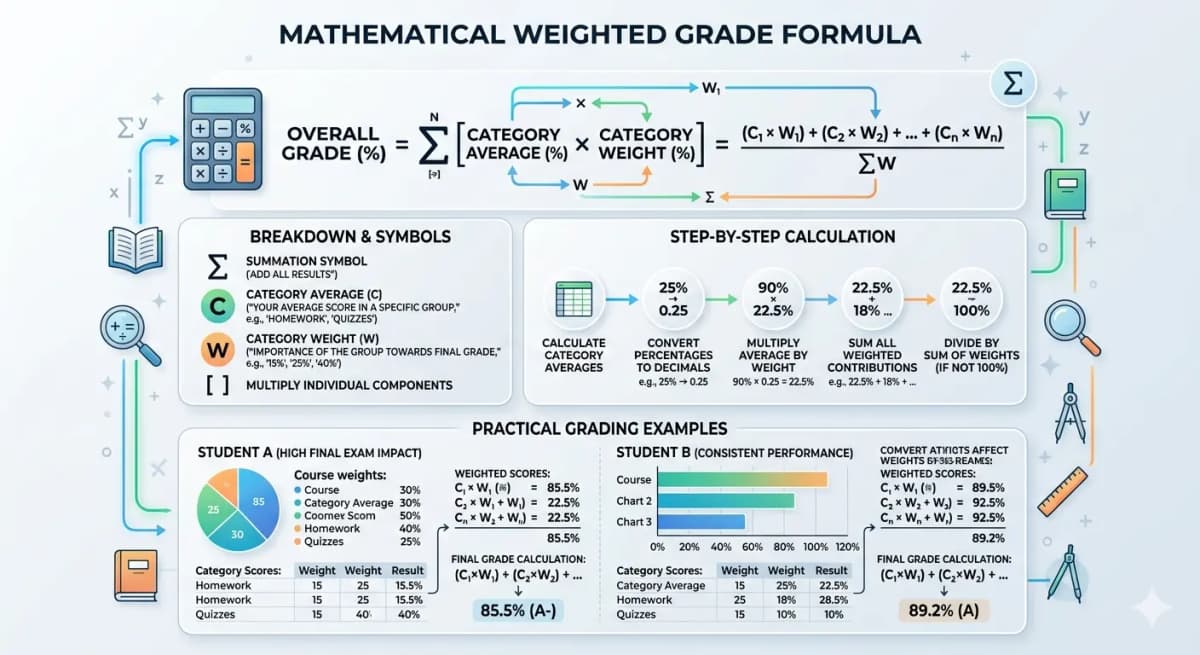
If all weights sum to exactly 1.0 (100%), you skip the division step — the sum of products is already your weighted grade. If your weights don't yet total 100% (mid-semester tracking), divide by the partial sum to get your grade so far.
How to Calculate Weighted Grades Manually — Step-by-Step Guide
- List all grade categories from your syllabus (Homework, Quizzes, Midterm, Final, Labs, Projects, etc.)
- Note the weight assigned to each category (e.g., Final Exam = 40%)
- Calculate your average score in each category if there are multiple assignments
- Convert weights to decimals (40% → 0.40)
- Multiply each score by its weight (Score × Weight)
- Add all products together — this is your weighted grade if weights sum to 1.0
- Divide by total weight if weights don't sum to 100% (for mid-semester tracking)
Real-World Example 1: High School Course Grade
A typical high school grading breakdown with five categories:
| Category | Your Score | Weight | Contribution (Score × Weight) |
|---|---|---|---|
| Homework | 92% | 20% | 18.40 |
| Quizzes | 85% | 15% | 12.75 |
| Classwork / Participation | 98% | 10% | 9.80 |
| Midterm Exam | 78% | 25% | 19.50 |
| Final Exam | 84% | 30% | 25.20 |
| Total | 100% | 85.65% → B | |
Real-World Example 2: College Course with Lab Component
| Category | Your Score | Weight | Contribution |
|---|---|---|---|
| Online Homework | 96% | 15% | 14.40 |
| Lab Reports | 88% | 20% | 17.60 |
| Midterm 1 | 74% | 15% | 11.10 |
| Midterm 2 | 81% | 15% | 12.15 |
| Research Project | 91% | 10% | 9.10 |
| Final Exam | 79% | 25% | 19.75 |
| Total | 100% | 84.10% → B | |
What Grade Do I Need on My Final Exam?
This is the most common question students have before finals week. The final exam grade calculator formula is:
Example:
Current grade: 80% | Pre-final weight: 70% | Final weight: 30% | Target: 85%
= (85 − 80 × 0.70) / 0.30
= (85 − 56) / 0.30
= 29 / 0.30
= 96.7% needed on final
Final Exam Impact Examples — How Much Is My Final Worth?
| Current Grade | Pre-Final Weight | Final Weight | Target | Score Needed on Final |
|---|---|---|---|---|
| 85% | 75% | 25% | 90% (A) | 105% ❌ |
| 80% | 70% | 30% | 85% (B+) | 96.7% ✅ |
| 72% | 75% | 25% | 70% (C) | 64.0% ✅ |
| 65% | 60% | 40% | 70% (C) | 77.5% ✅ |
| 90% | 80% | 20% | 93% (A) | 87.0% ✅ |
| 55% | 70% | 30% | 70% (C) | 101.7% ❌ |
📌 Key Takeaway: Final Exam Reality Check
If the required score exceeds 100%, your target grade is mathematically impossible regardless of how well you do on the final. Use our calculator above to check your situation early — not the night before.
Common Mistakes Students Make with Weighted Grades
| Mistake | Why It's Wrong | Correct Approach |
|---|---|---|
| Averaging all scores equally | Ignores the weight each category carries | Multiply each score by its weight first |
| Weights not summing to 100% | Missing categories give a falsely inflated grade | Always verify your total weight = 100% |
| Using points instead of percentages | Raw points aren't comparable across categories | Convert to % first: (earned / possible) × 100 |
| Forgetting incomplete categories | Mid-semester grades are partial — weights don't total 100% | Divide by completed weight only, not 1.0 |
| Ignoring the final exam weight | A 40% final can drop an A to a C | Calculate required final score before exam week |
Grade Scale Reference — Percentage to Letter Grade
| Percentage Range | Letter Grade | GPA (4.0 Scale) | Description |
|---|---|---|---|
| 93–100% | A | 4.0 | Excellent |
| 90–92% | A− | 3.7 | Excellent |
| 87–89% | B+ | 3.3 | Above Average |
| 83–86% | B | 3.0 | Above Average |
| 80–82% | B− | 2.7 | Above Average |
| 77–79% | C+ | 2.3 | Average |
| 73–76% | C | 2.0 | Average |
| 70–72% | C− | 1.7 | Average |
| 60–69% | D | 1.0 | Below Average |
| Below 60% | F | 0.0 | Failing |
Voice Search Quick Answers — Common Student Questions
🎙 How do weighted grades work?
Weighted grades assign each assignment type a percentage weight. Your score in each category is multiplied by its weight, and all results are summed. Categories worth more (like exams) impact your grade more than low-weight ones (like participation).
🎙 What is the weighted grade formula?
Weighted Grade = Σ(Score × Weight) / ΣWeights. Multiply each category score by its decimal weight, add all products, then divide by total weight (usually 1.0).
🎙 How much does my final exam affect my grade?
It depends on its assigned weight. A 25% final can shift your grade by up to 25 percentage points. Use the formula: Impact = (Final Exam Score − Current Grade) × Final Weight.
🎙 What grade do I need on my final to pass?
Required Final Score = (Target Grade − Current Grade × Pre-Final Weight) / Final Exam Weight. For example, needing a 70% with 65% current grade, 75% pre-final weight, 25% final weight: (70 − 65×0.75) / 0.25 = 85%.
🎙 Is a 85% a B or a B+?
On the standard US grading scale, 85% is a B (83–86%). Some schools with plus/minus grading count 85% as a B, while others may consider it B+. Check your school's specific grade cutoffs.
More Academic & Grade Calculators
Pair this weighted grade calculator with our other free academic tools:
- GPA Calculator — Convert letter grades to a 4.0 GPA scale across all semesters
- Percentage Calculator — Convert raw scores to percentage grades instantly
Written by Rana Muhammad Abdullah
MERN Stack Developer & Tool Maker · Mechatronics & Control Engineering Student · LinkedIn
Your grade is more than a number — it's the product of every assignment you've put effort into, weighted by what your professor values most. Use LizoCalc's Weighted Grade Calculator to stay ahead, plan smart, and walk into finals week with confidence.